Program Learning Outcome (PLO) #1 Assessment - Core Knowledge
Author
Sam Shanny-Csik & Jamie Montgomery
Published
August 13, 2024
Modified
June 23, 2025
Summary
This PLO assessment was administered to the MEDS class of 2025 both before beginning the program, on August 2, 2024 (response rate = 29/29 students), and again after completing the program, on June 4, 2024 (response rate = 30/30 students).
Discrepancy in total # of students in Pre- and Post-MEDS PLO assessments
One student from the class of 2025 completed MEDS in two years and therefore only took this PLO assessment at the end of the program.
The survey consists of 31 questions (28 multiple choice, 3 short free-response) and takes ~30 minutes to complete. Questions 1 - 15 ask respondents to rank how often they use certain data science tools or workflows, or familiarity / comfort levels with particular topics (see Part 1 through Part 4, below). Questions 16 - 31 assess respondents’ familiarity and application of domain-specific knowledge / tools taught during the MEDS program (see Part 5 onward, below). Many of these question types are multi-part and begin with a question phrased as:
“How familiar / comfortable are you with X” (rank 1 (never heard of it) > 5 (very familiar))
“Have often have you done / implemented Y” (rank 1 (never) > 5 (all the time))
If a respondent chooses a level of 2 or greater, they proceed to the remaining part(s) of the question to be tested on their knowledge / understanding of that topic. If a respondent chooses a level 1, they are skipped to the next question. These questions act as “gates” which prevent respondents who are unfamiliar with a topic from proceeding to and guessing on questions which are meant to test knowledge / understanding.
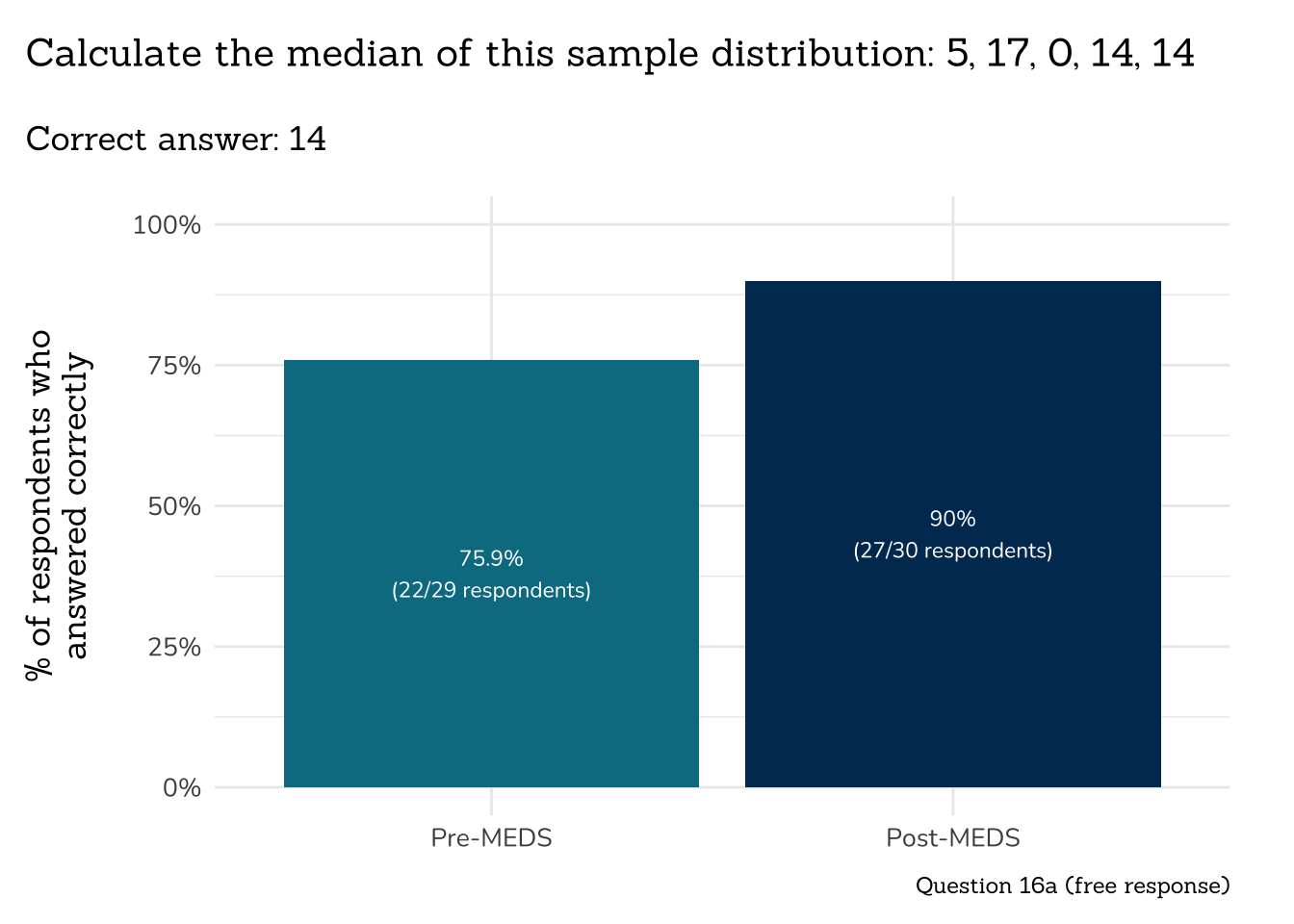
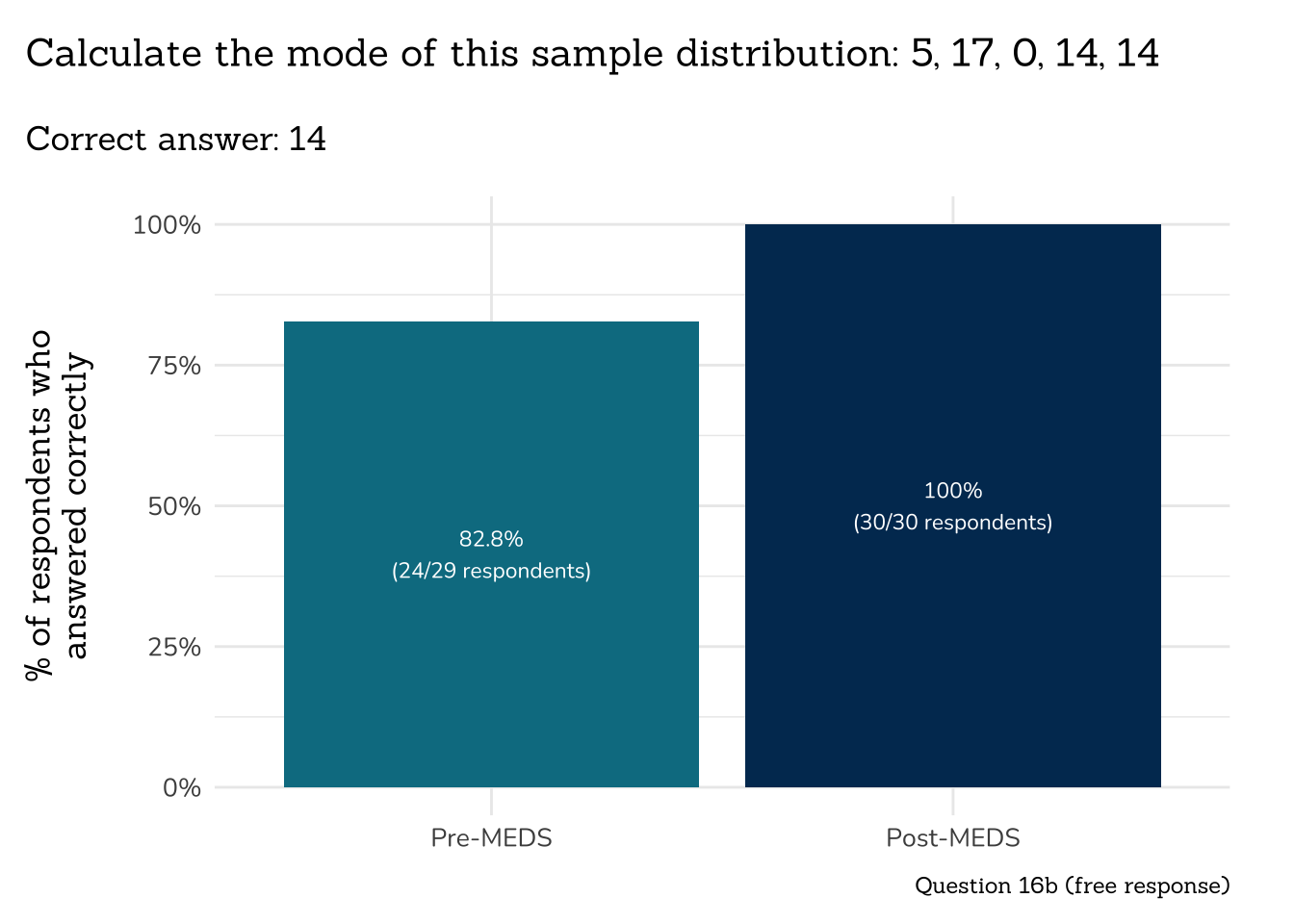
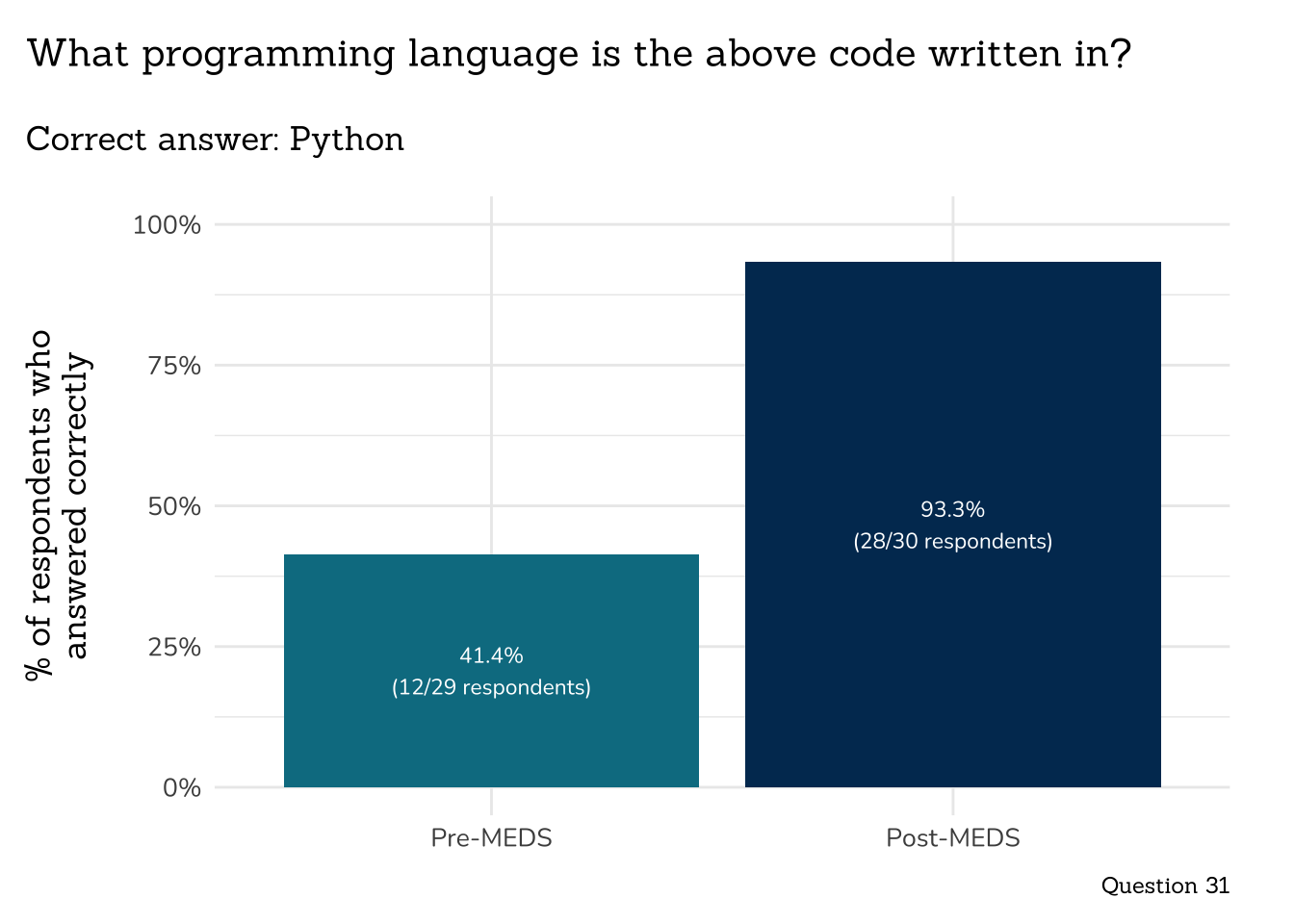
There are 14 questions which have a correct answer. These questions always follow at least one “gate” question. The results of these questions are presented as a comparison between the percentage of Pre- and Post-MEDS respondents who answered it correctly. It’s important to note that these percentages are calculated based on the total number of students who participated in the assessment (that is 29 for the Pre-MEDS assessment and 30 for the Post-MEDS assessment), and not the number of students who proceeded past the “gate” question(s).
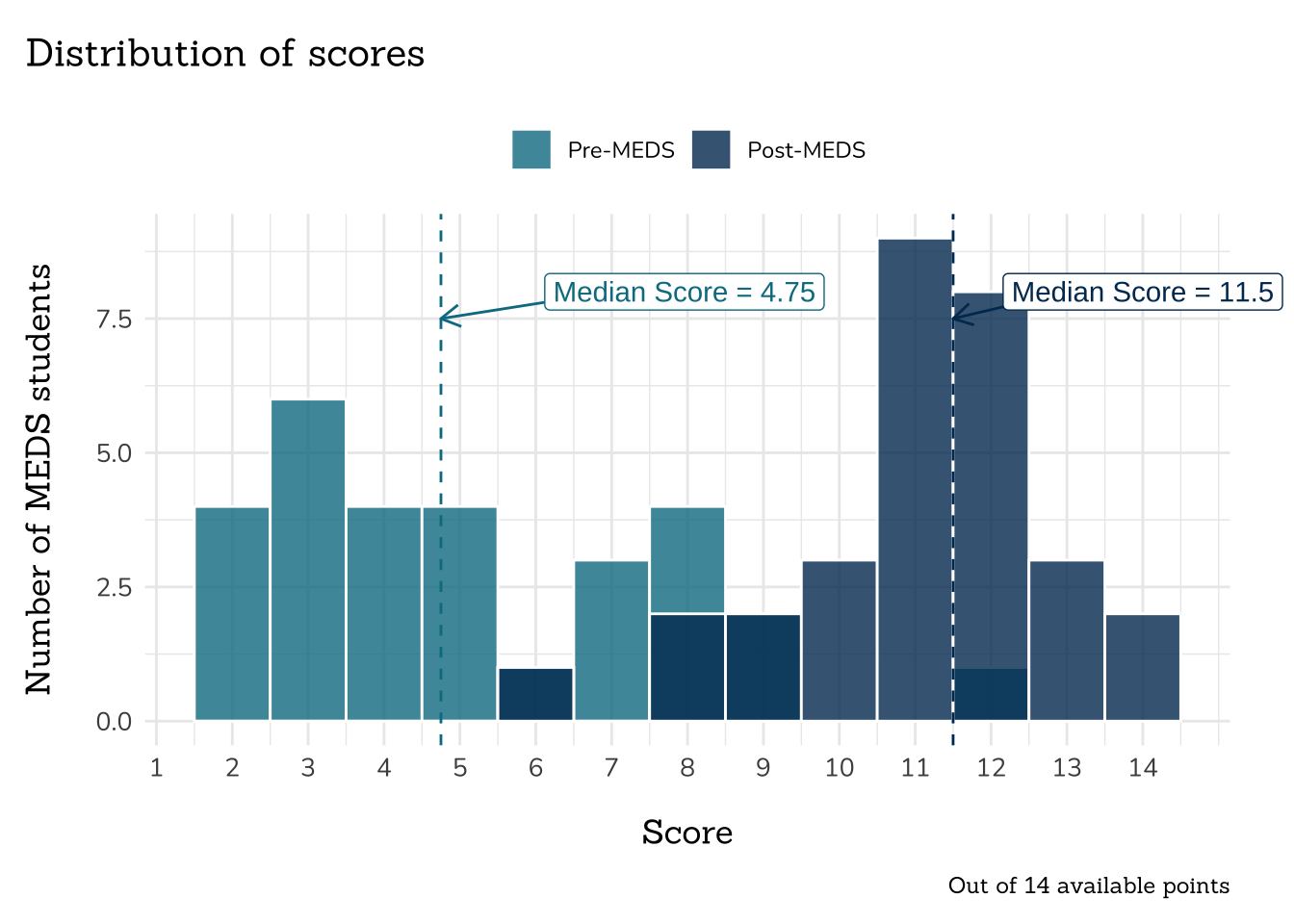
A perfect score is 14 points. The median score increased by 142.1% from the pre- to post-MEDS PLO assessments.
Individual Questions
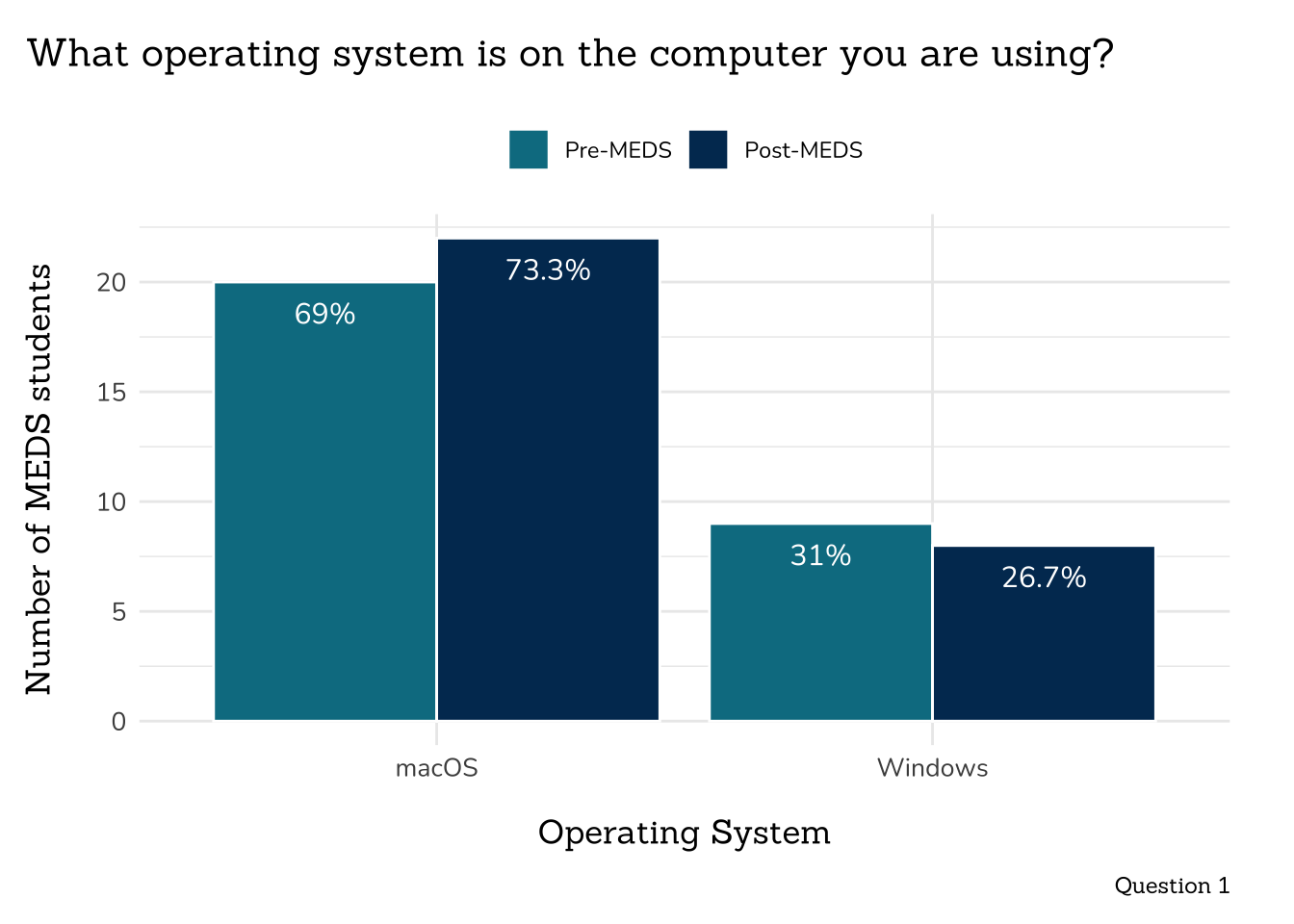
Part 1: OS and data/document storage
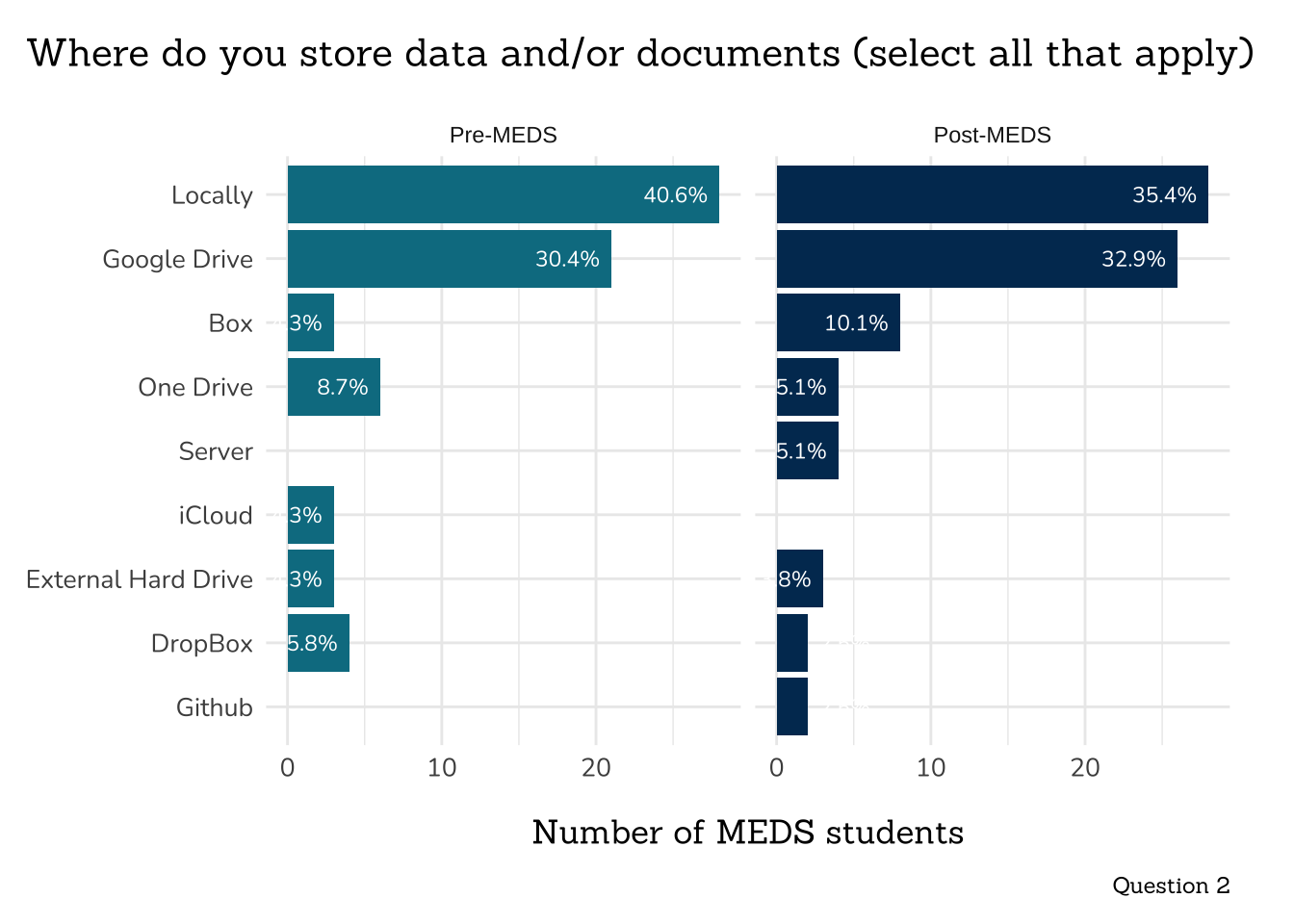
NOTE: Percentages will not sum to 100%
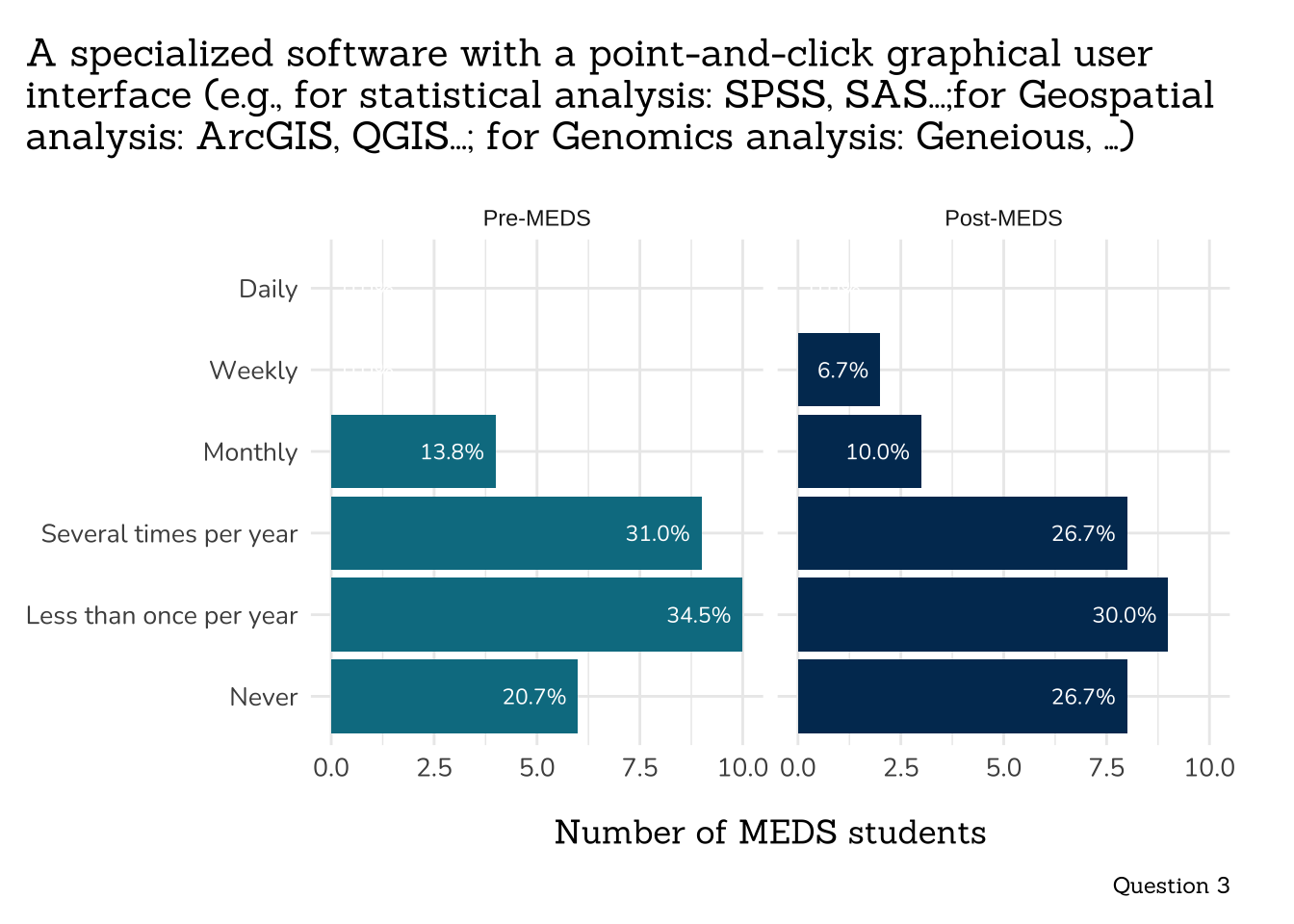
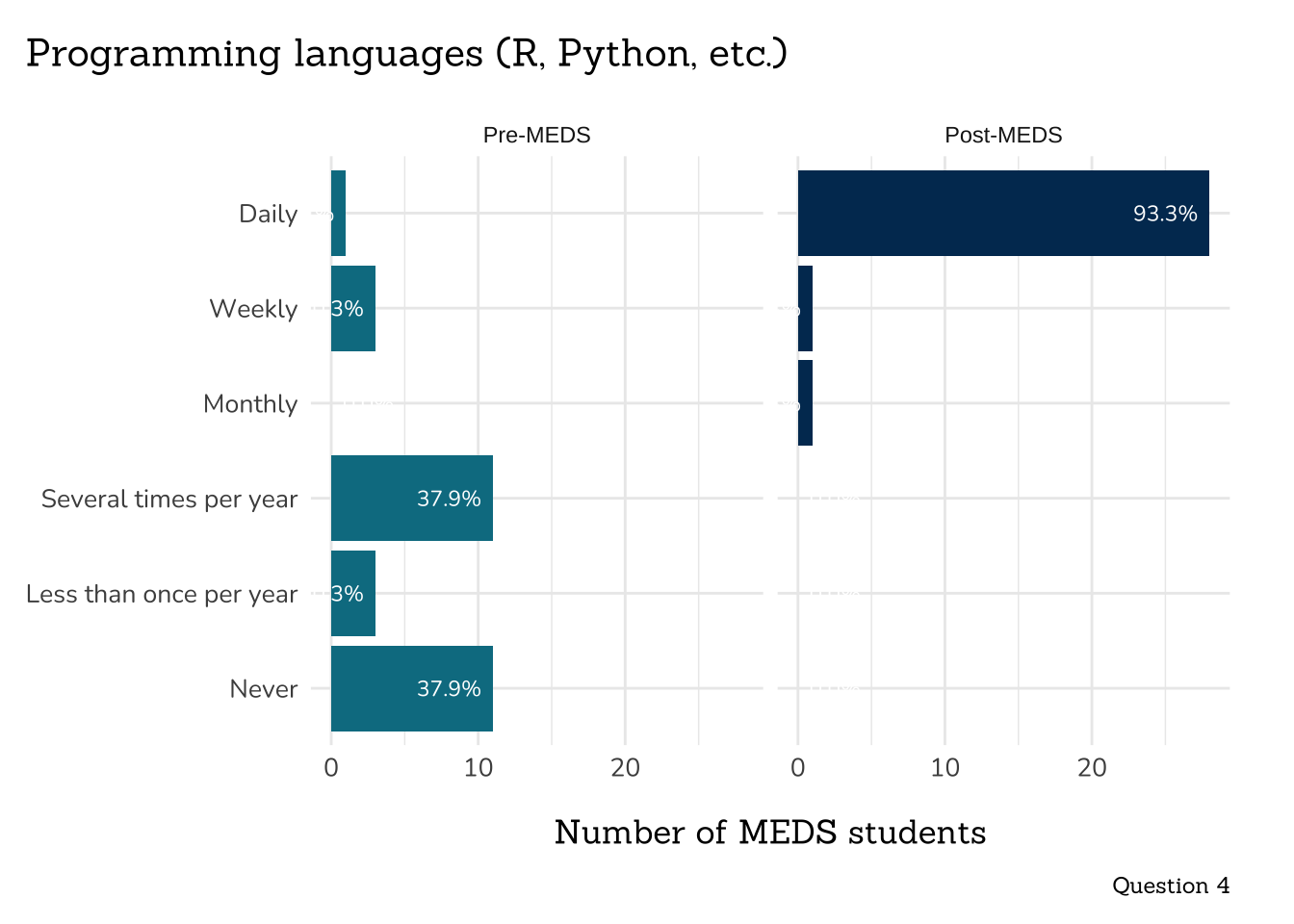
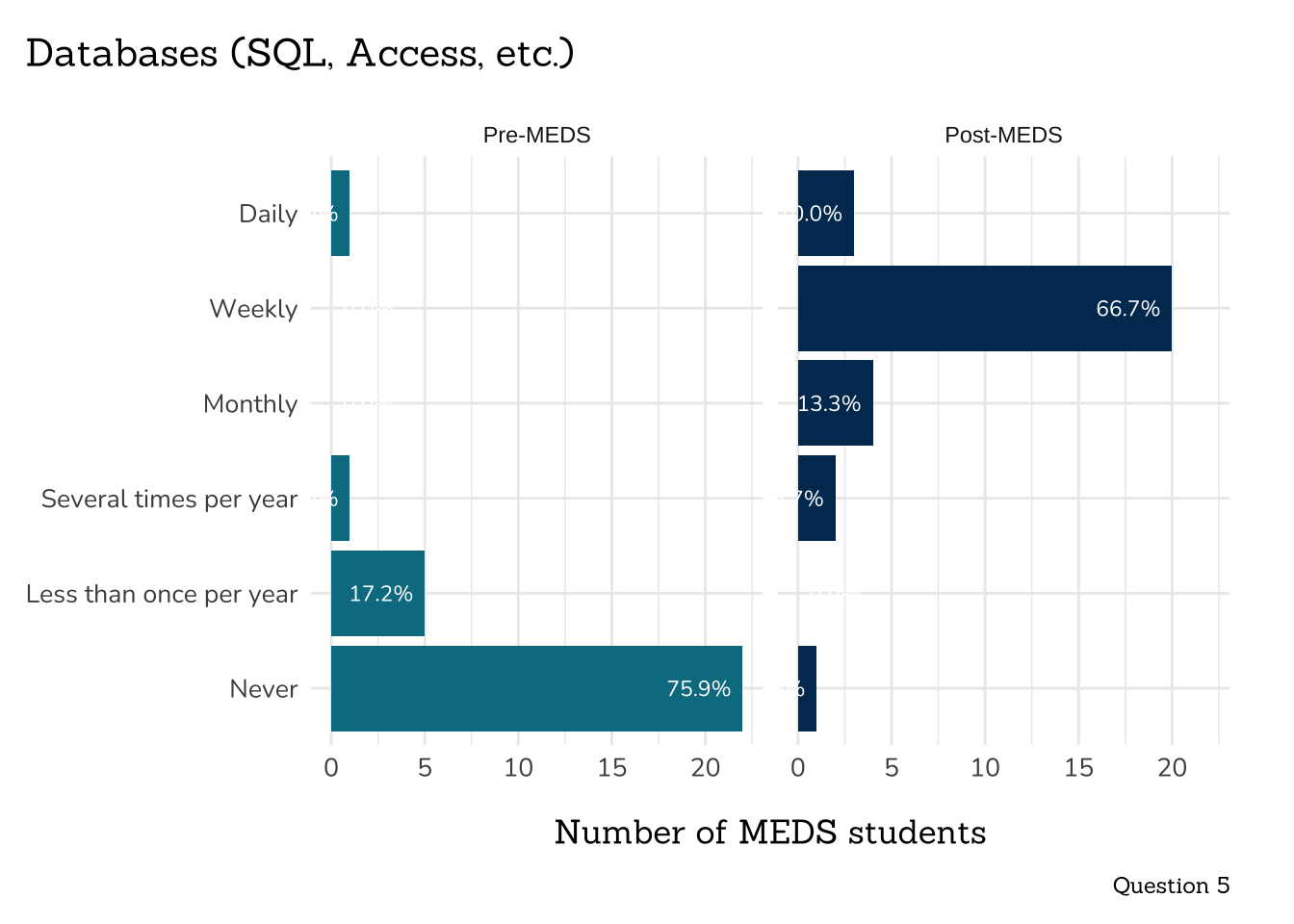
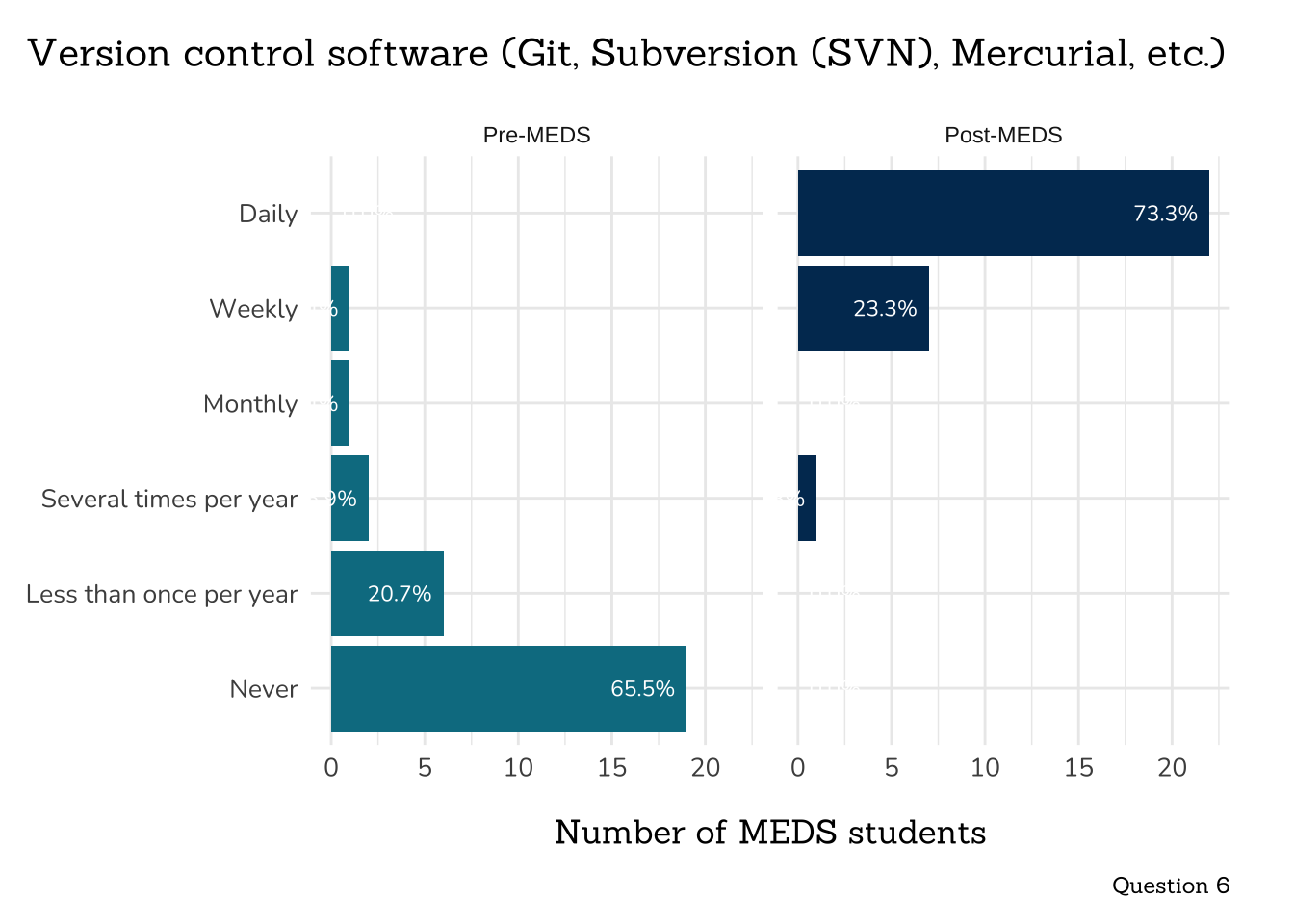
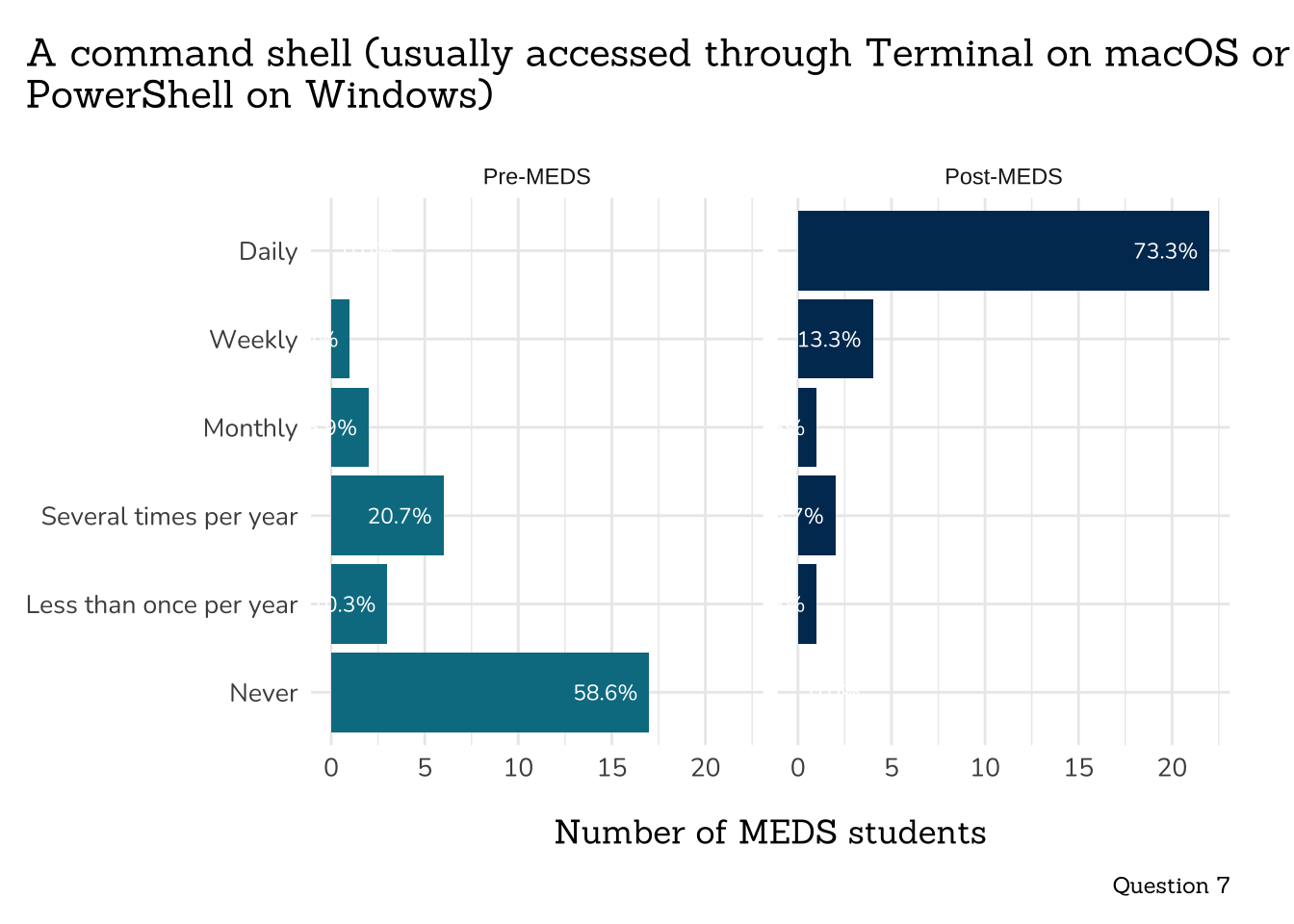
Part 2: How often do you currently use the following?
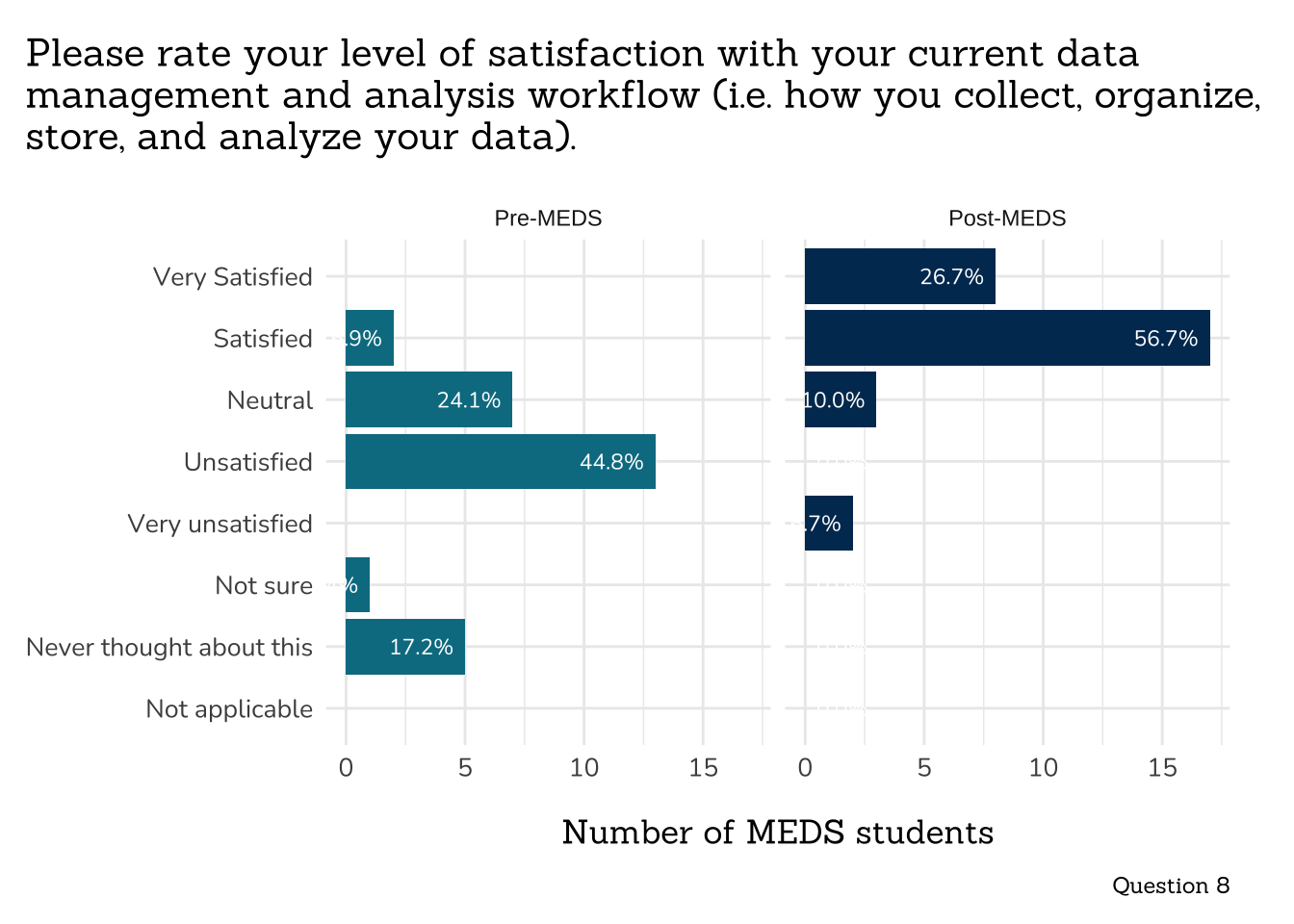
Part 3: Workflow satisfaction
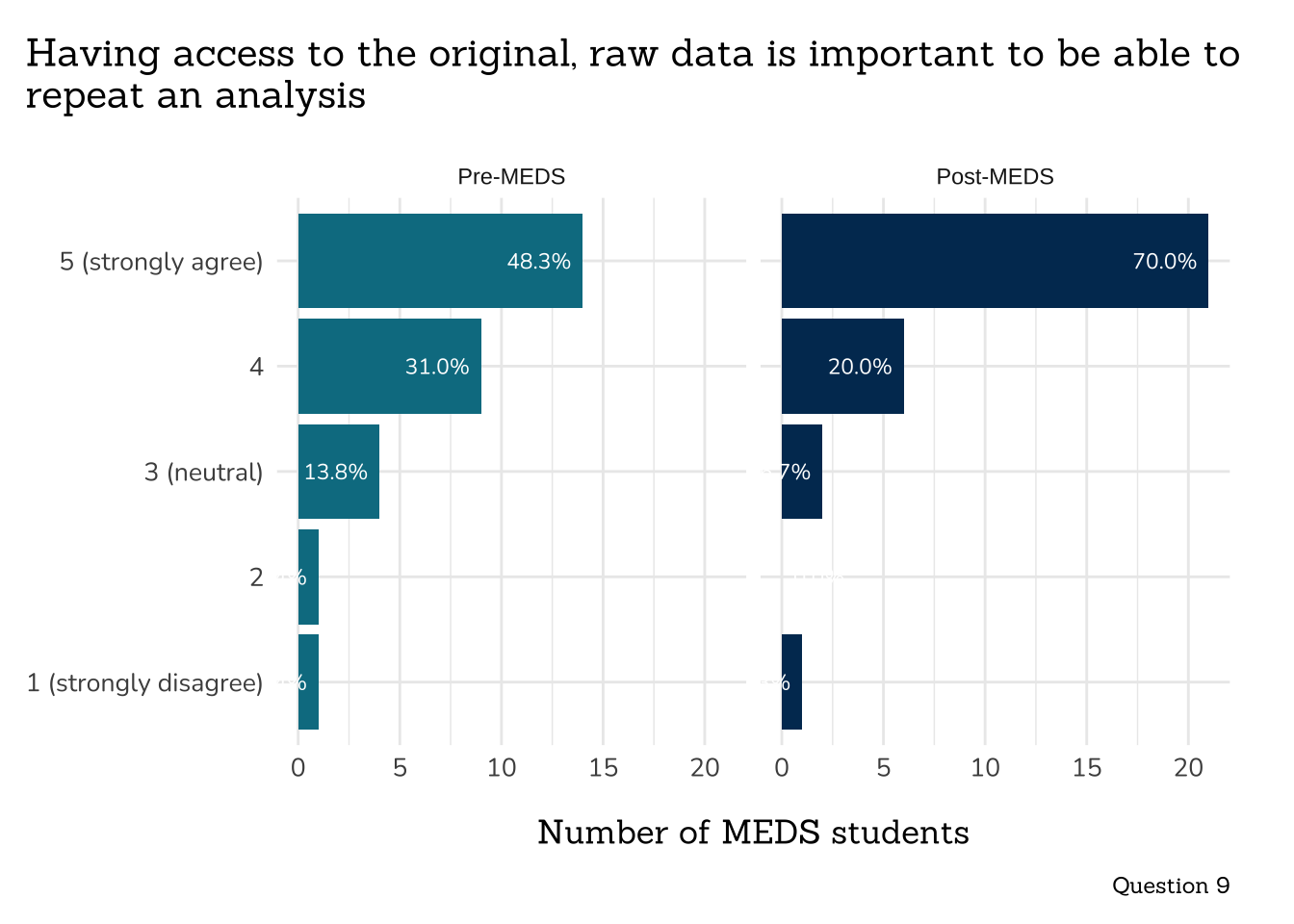
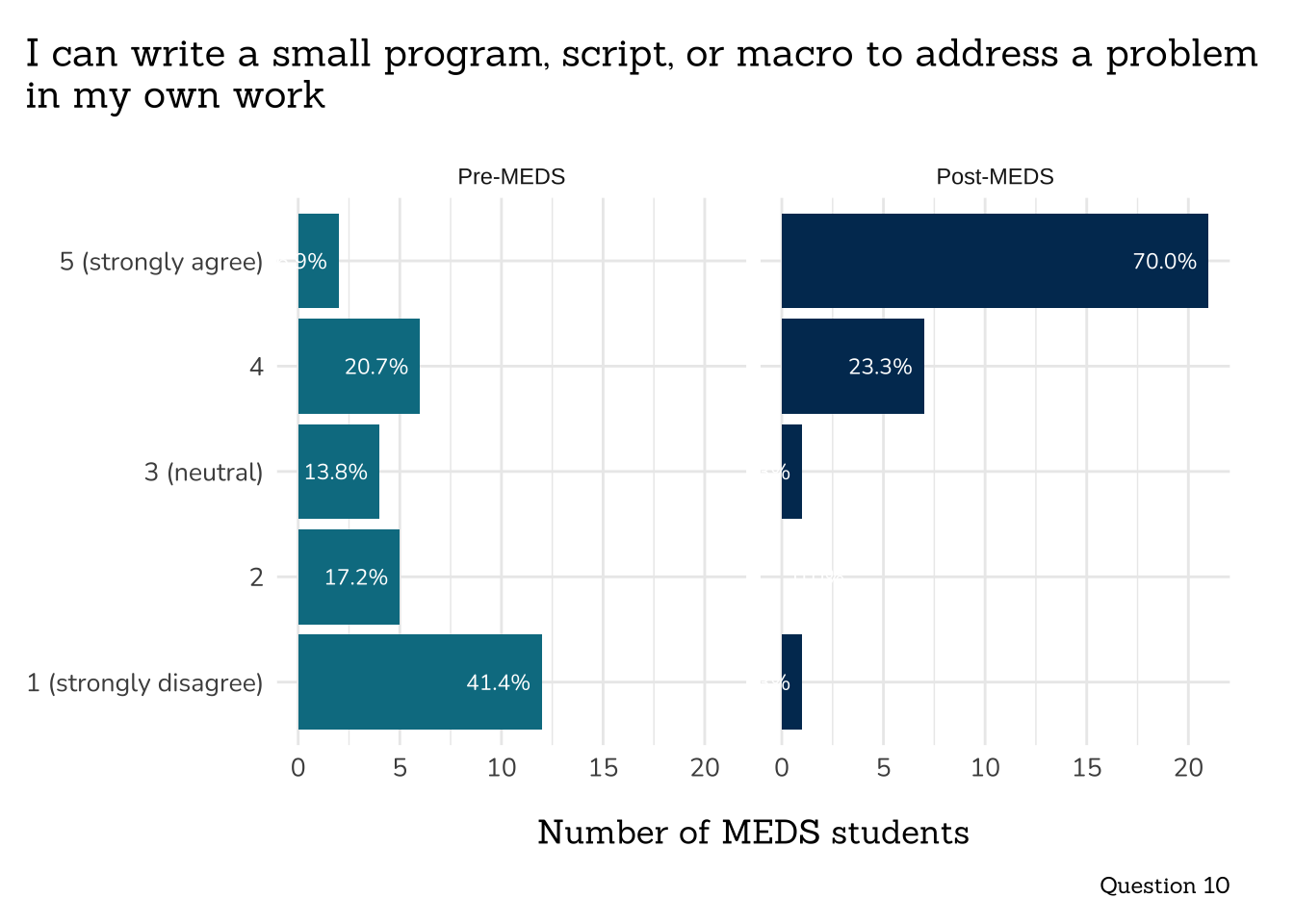
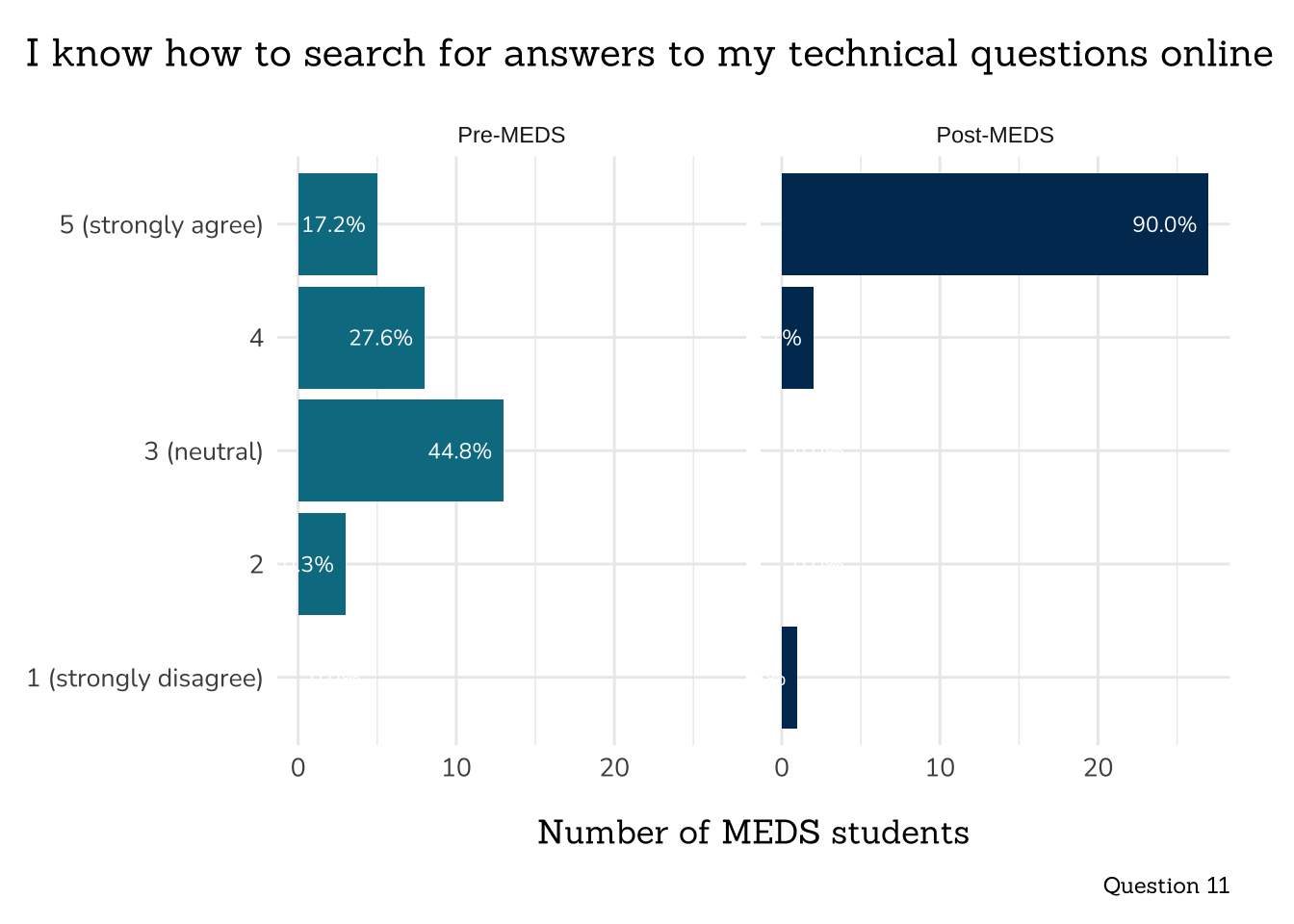
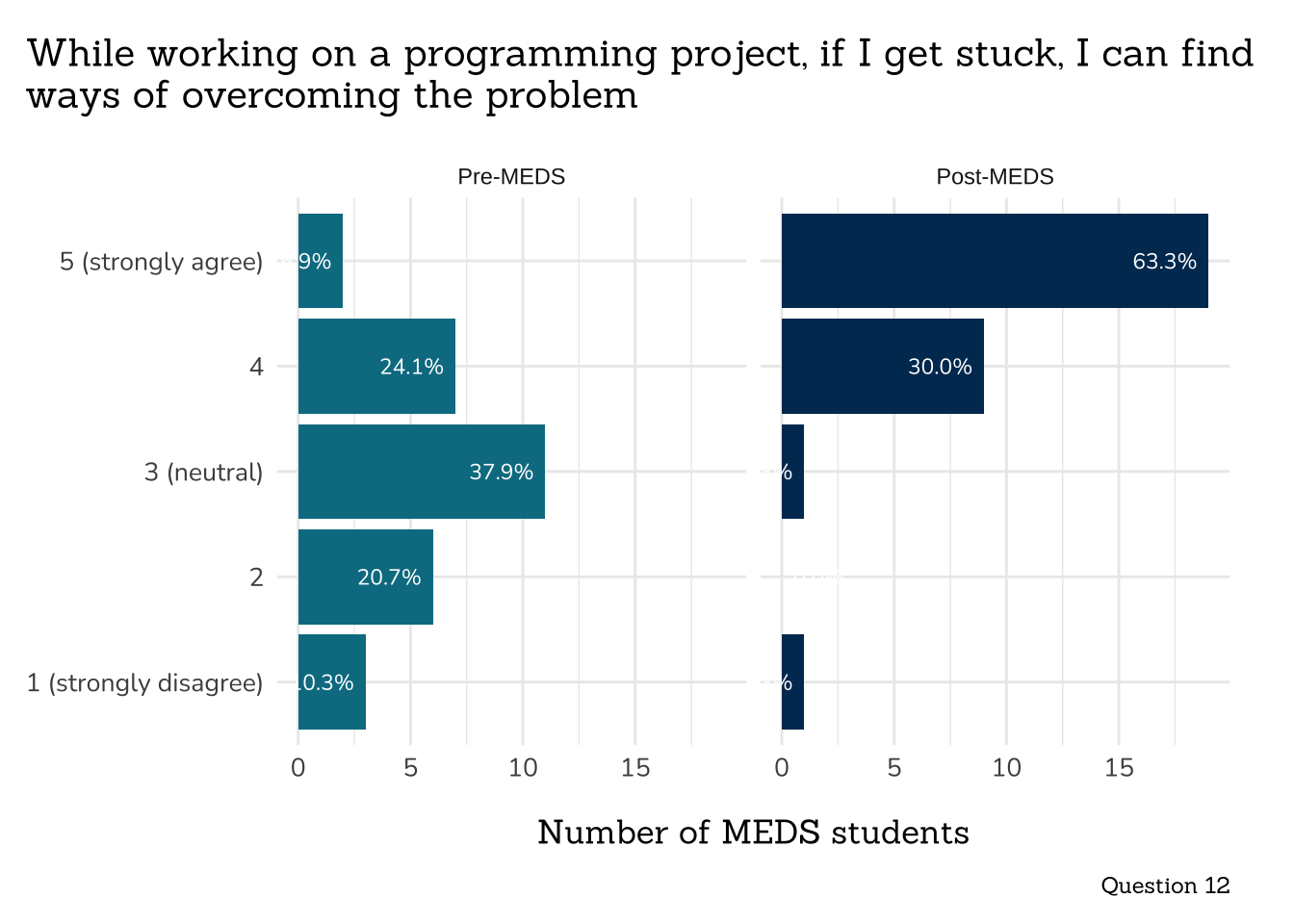
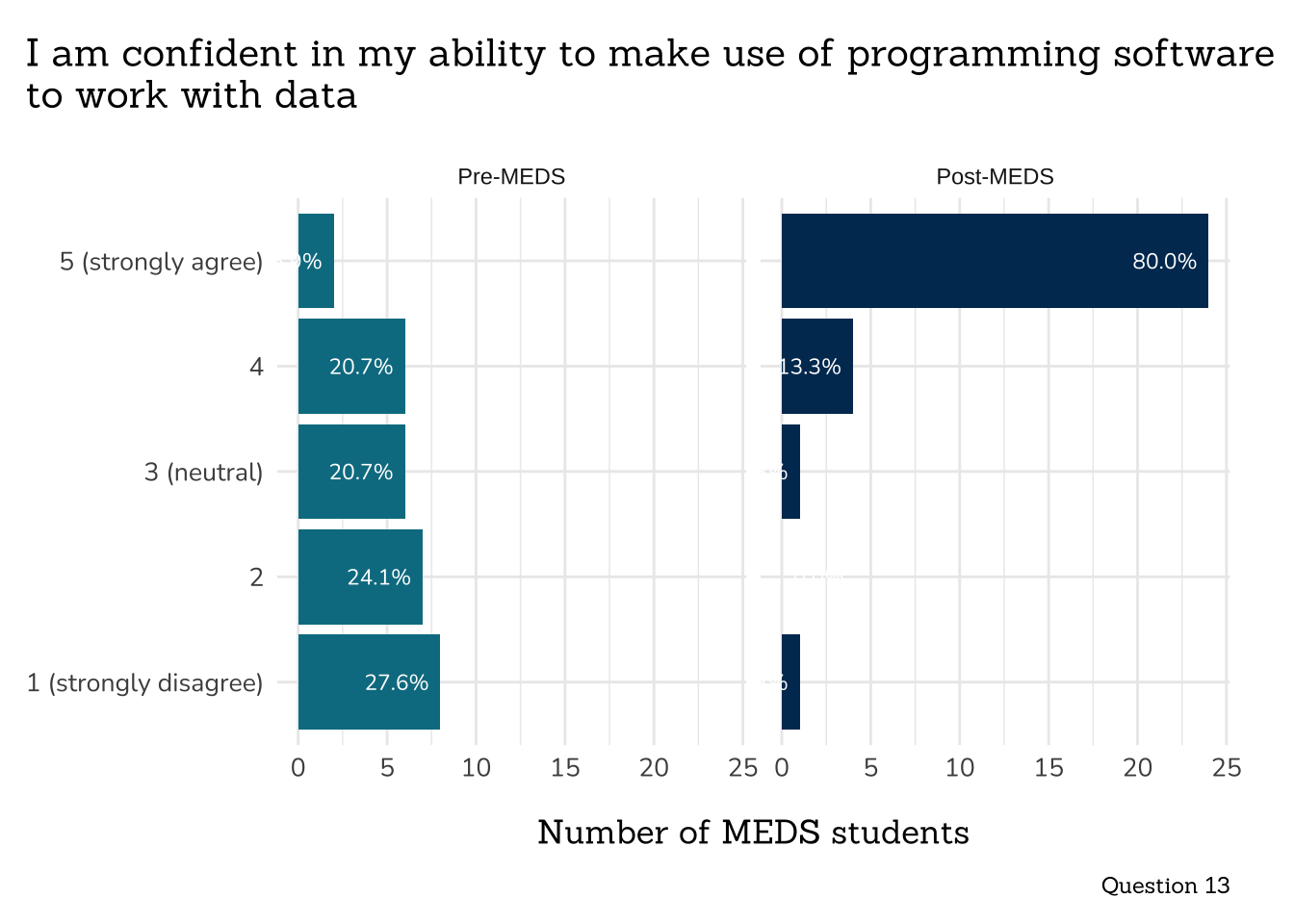
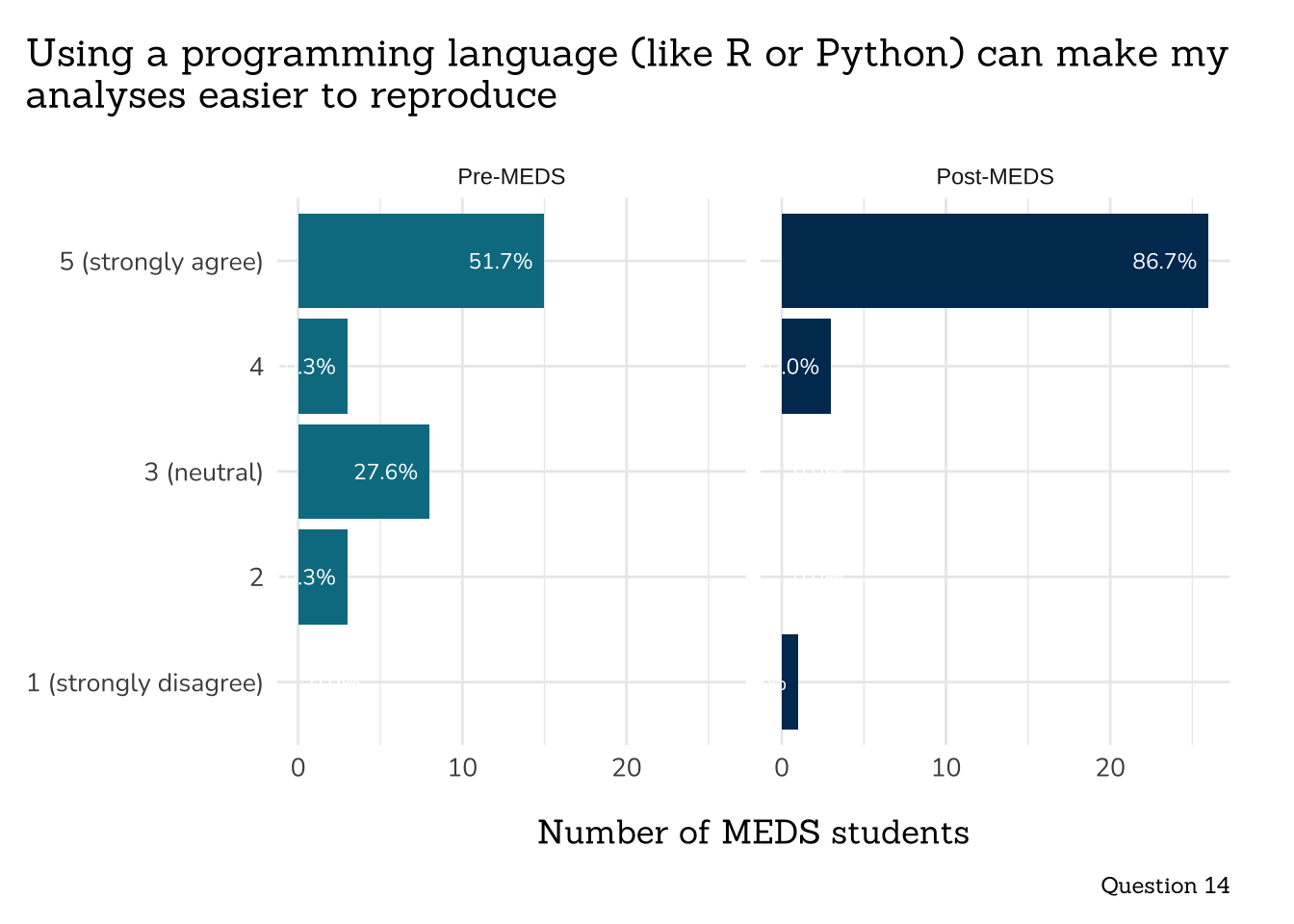
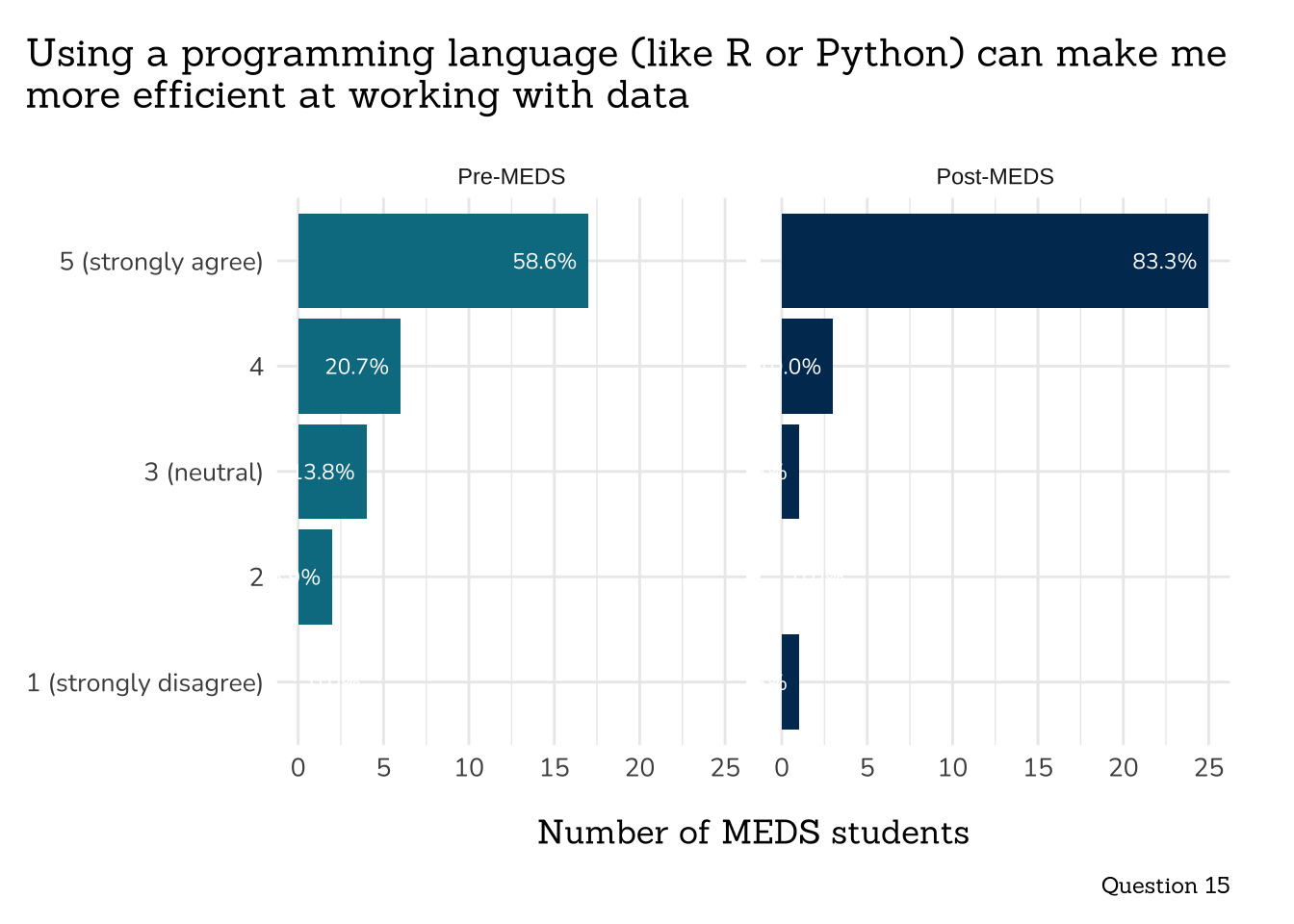
Part 4: Rank the following from 1 (strongly disagree) to 5 (strongly agree)
Unusual respondent
One respondent in the Post-MEDS PLO assessment answered 1 (strongly disagree) to all questions 9 - 15.
Part 5: Stats
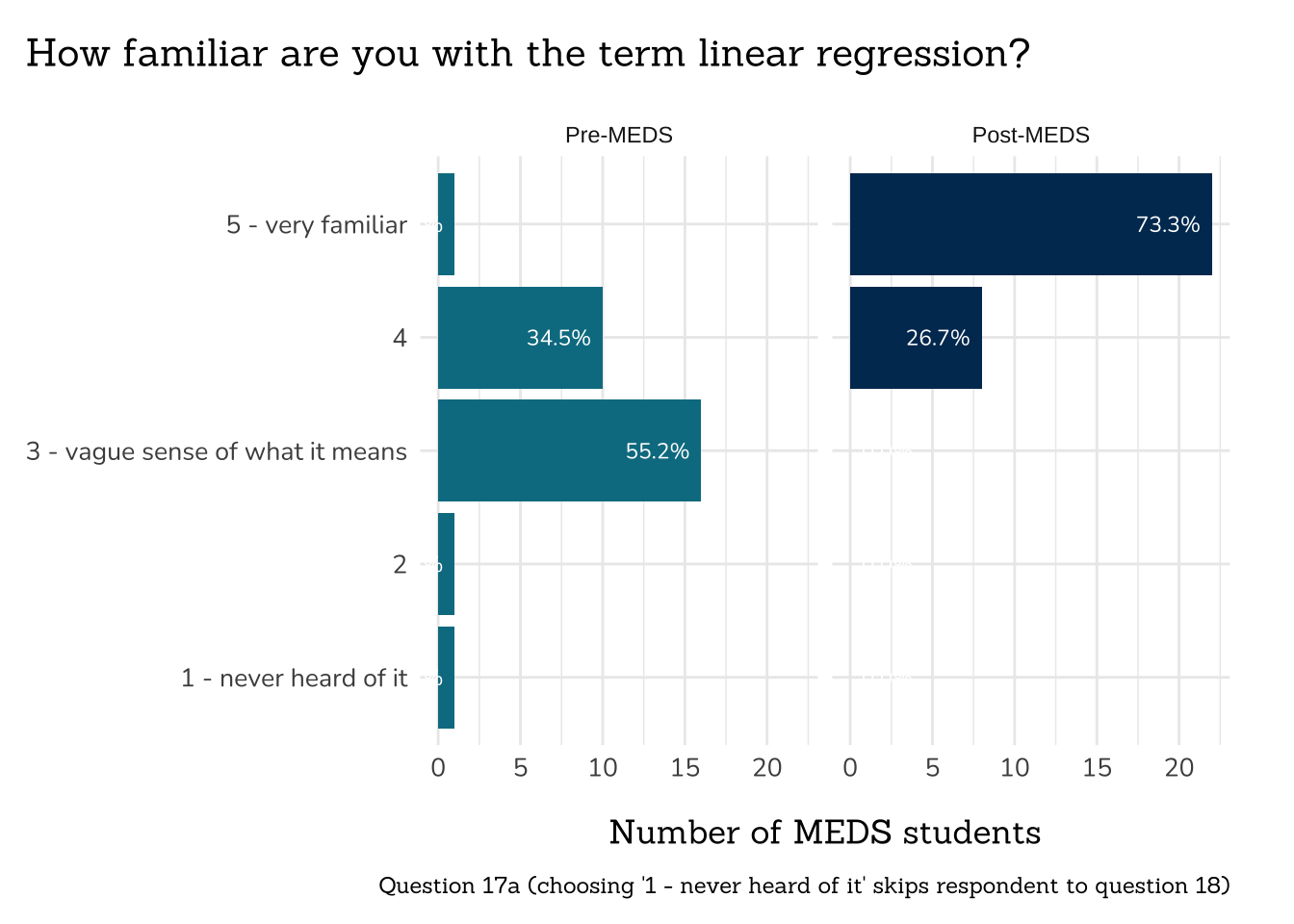
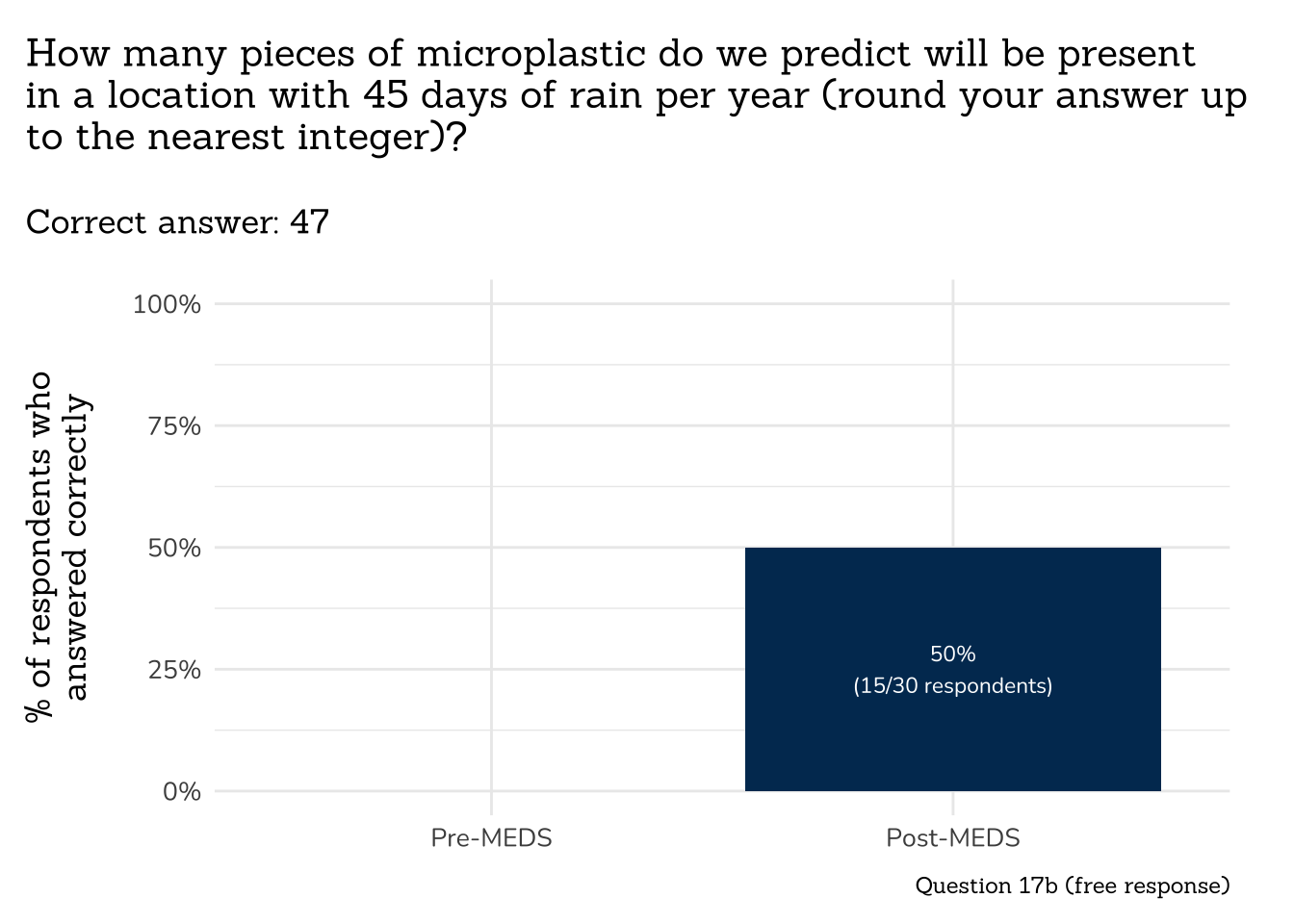
All Post-MEDS respondents were directed to answer Question 17b, as compared to 28 / 29 respondents in the Pre-MEDS PLO Assessment.
Pre-MEDS: 28 / 29 student respondents (96.6%) chose a familiarity level of 2 or greater, and therefore were directed to answer all parts of Question 17b.
Post-MEDS: 30 / 30 student respondents (100%) chose a familiarity level of 2 or greater, and therefore were directed to answer all parts of Question 17b.
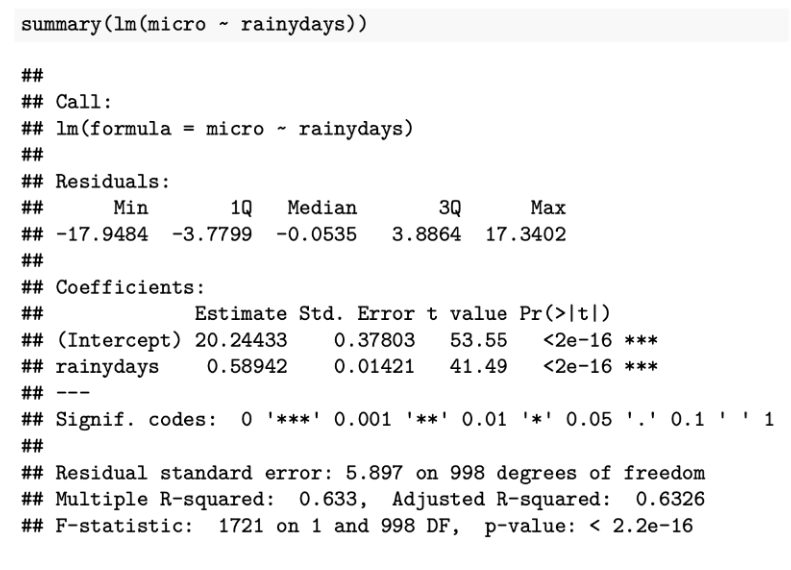
Below is a chunk of code showing a simple linear regression relating the number of pieces of microplastics to the number of days per year with rainfall.
Question 17b raw responses
Respondents submitted a wide variety of answers – responses as they were recorded are included in the tables, below:
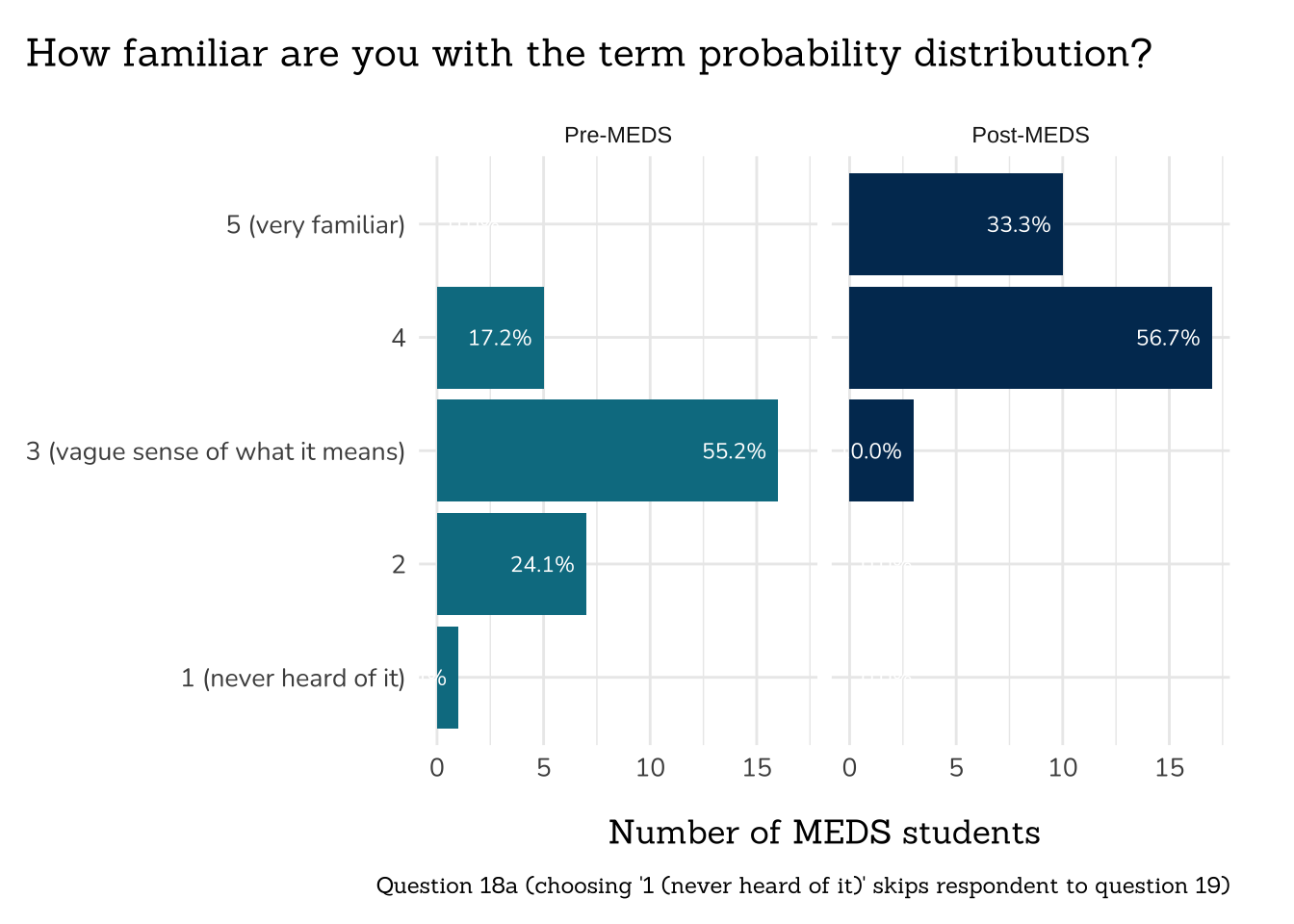
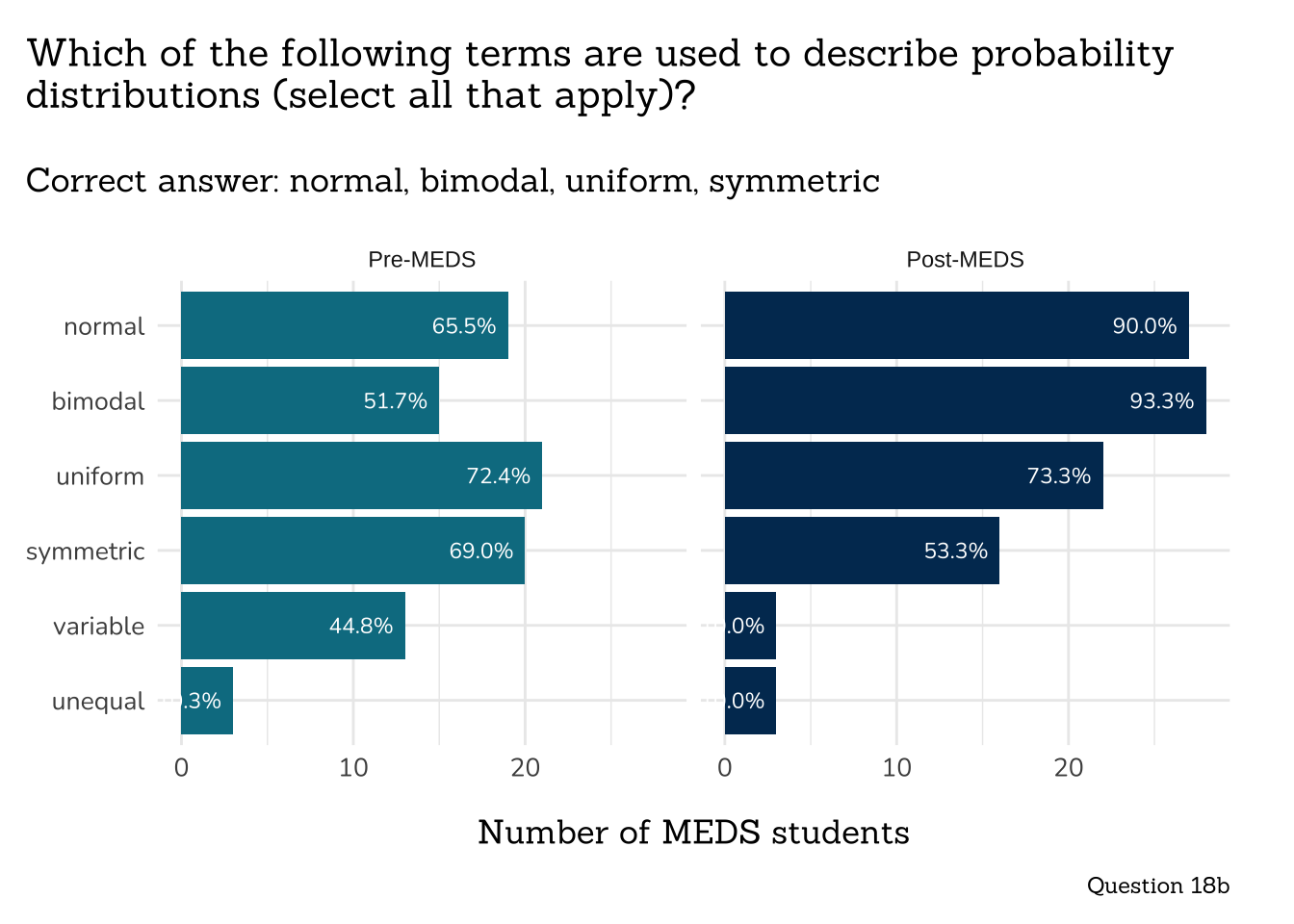
All Post-MEDS respondents were directed to answer Question 18b, as compared to 28 / 29 respondents in the Pre-MEDS PLO Assessment.
Pre-MEDS: 28 / 29 student respondents (96.6%) chose a familiarity level of 2 or greater, and therefore were directed to answer all parts of Question 18b.
Post-MEDS: 30 / 30 student respondents (100%) chose a familiarity level of 2 or greater, and therefore were directed to answer all parts of Question 18b.
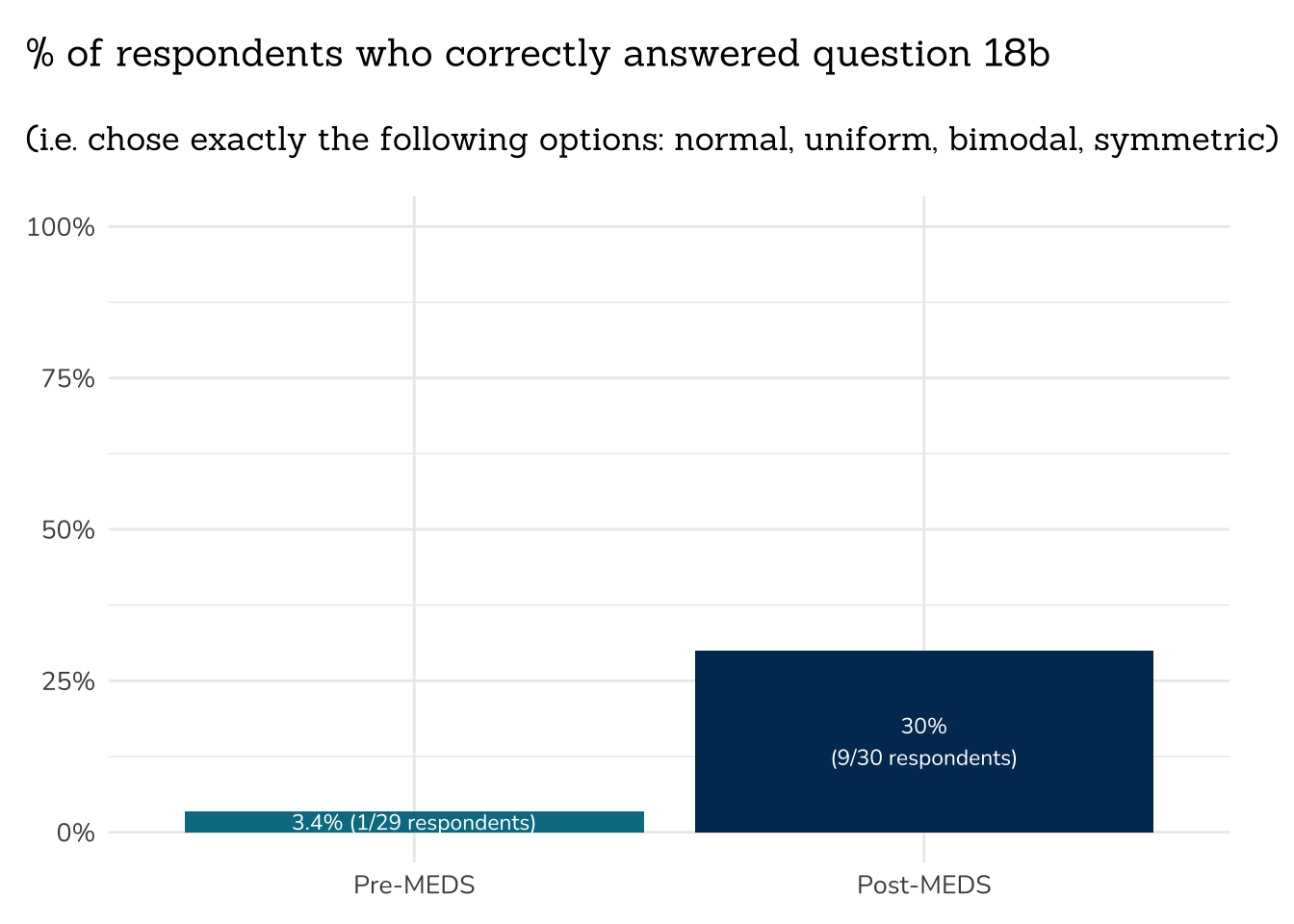
The percentage of respondents who provided a fully correct answer to Queston 18b increased from Pre- to Post-MEDS PLO assessments
Only students who chose 2 or greater in Question 18a were directed to answer Question 18b. A fully correct answer means choosing exactly the following options: normal, uniform, bimodal, symmetrical.
Part 6: Programming 1
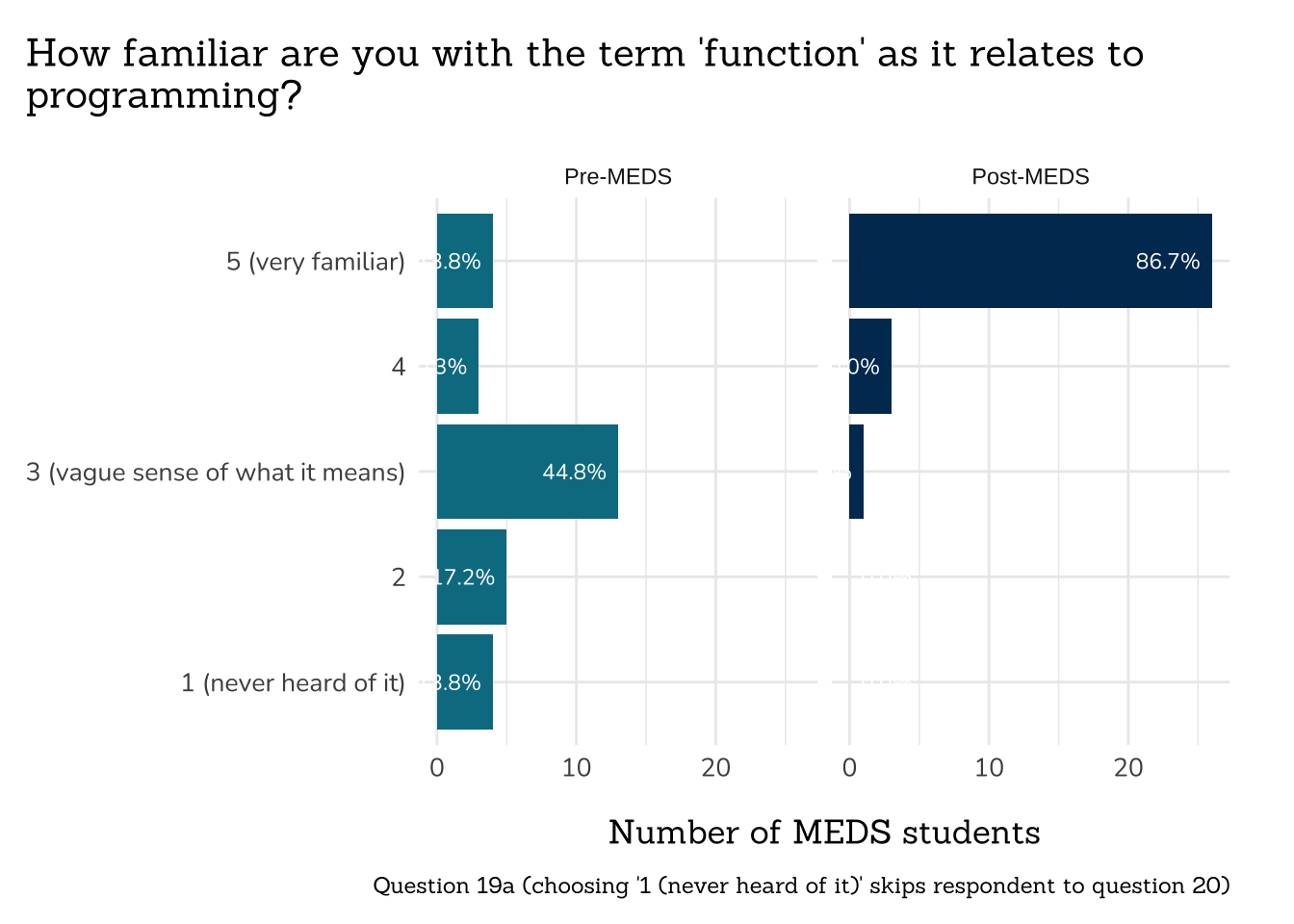
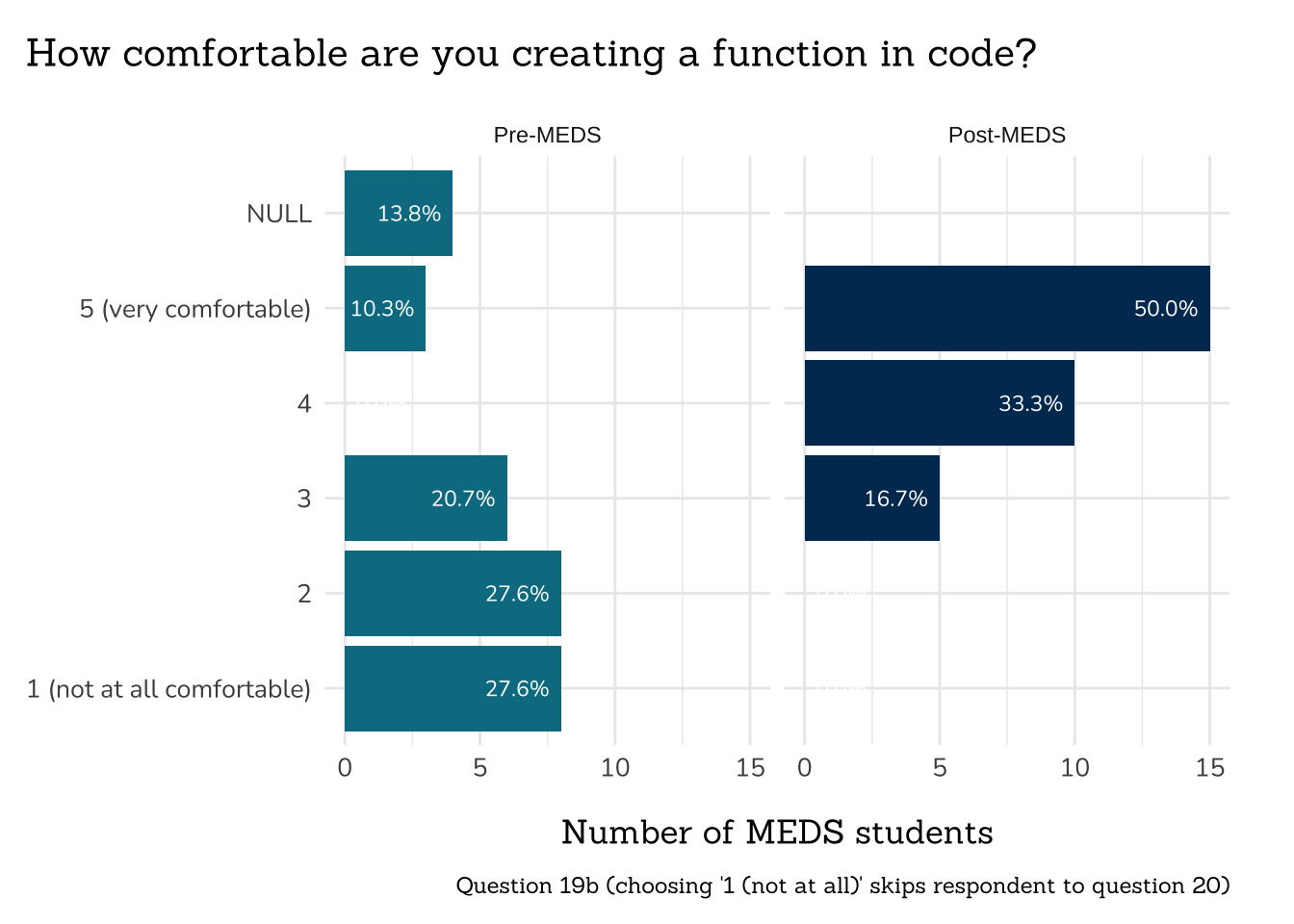
All Post-MEDS respondents were directed to answer Question 19b, as compared to 25 / 29 respondents in the Pre-MEDS PLO Assessment.
Pre-MEDS: 25/29 student respondents (86.2%) chose a familiarity level of 2 or greater, and therefore were directed to answer question 19b.
Post-MEDS: 30/30 student respondents (100%) chose a familiarity level of 2 or greater, and therefore were directed to answer question 19b.
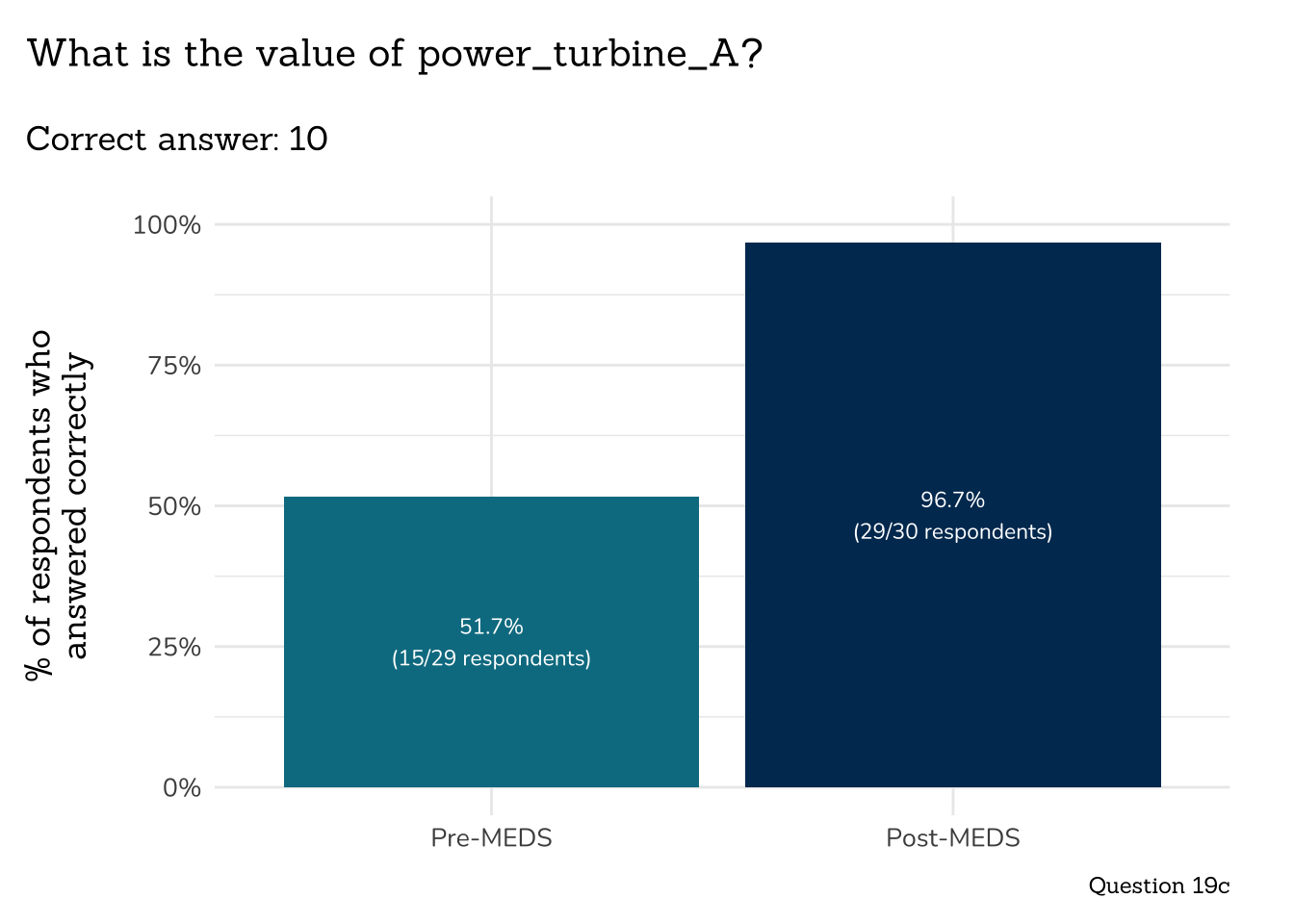
All Post-MEDS respondents were directed to answer Question 19c, as compared to 21 / 29 respondents in the Pre-MEDS PLO Assessment.
Pre-MEDS: 21/29 student respondents (72.4%) chose a familiarity level of 2 or greater, and therefore were directed to answer question 19c.
Post-MEDS: 30/30 student respondents (100%) chose a familiarity level of 2 or greater, and therefore were directed to answer question 19c.
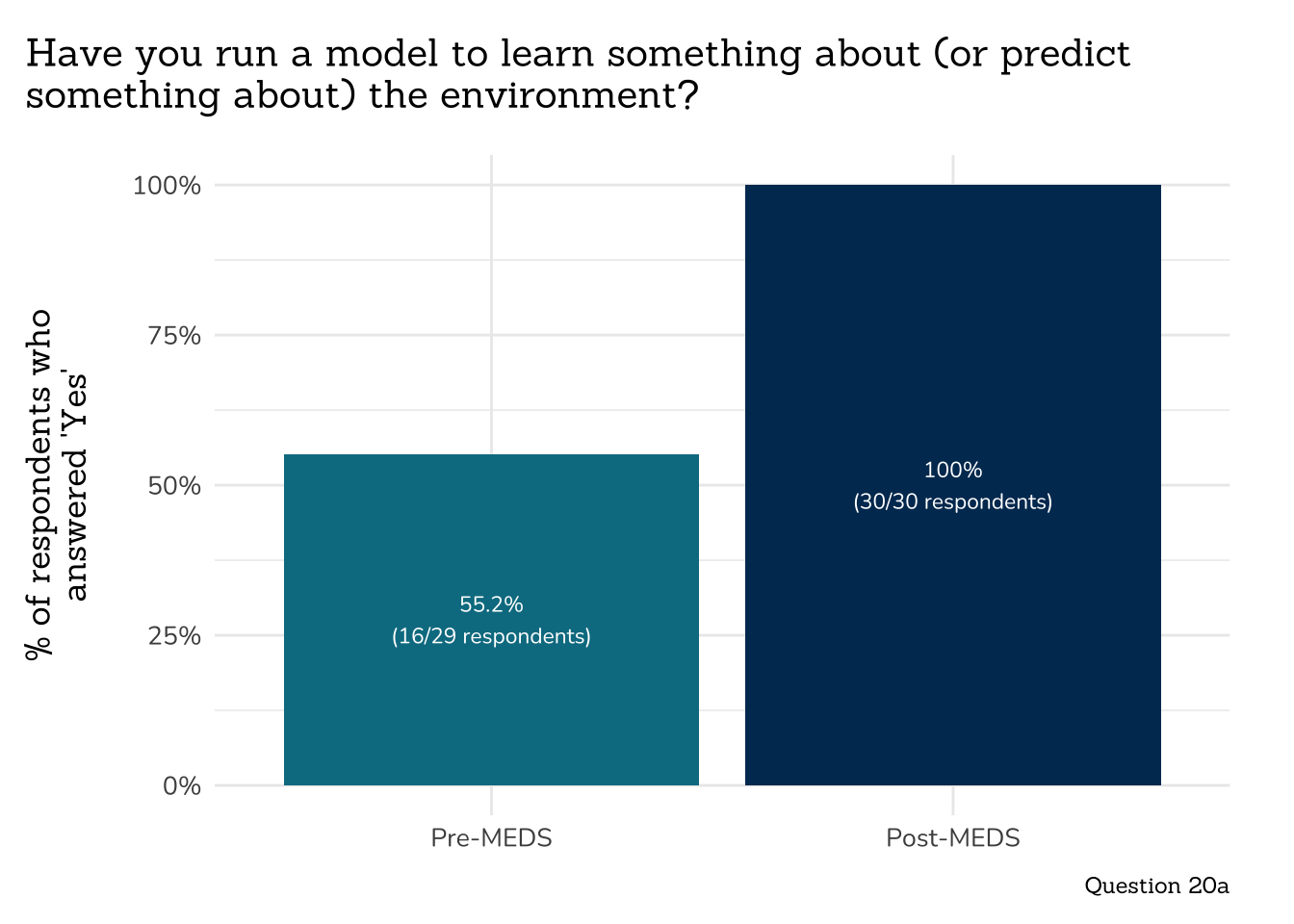
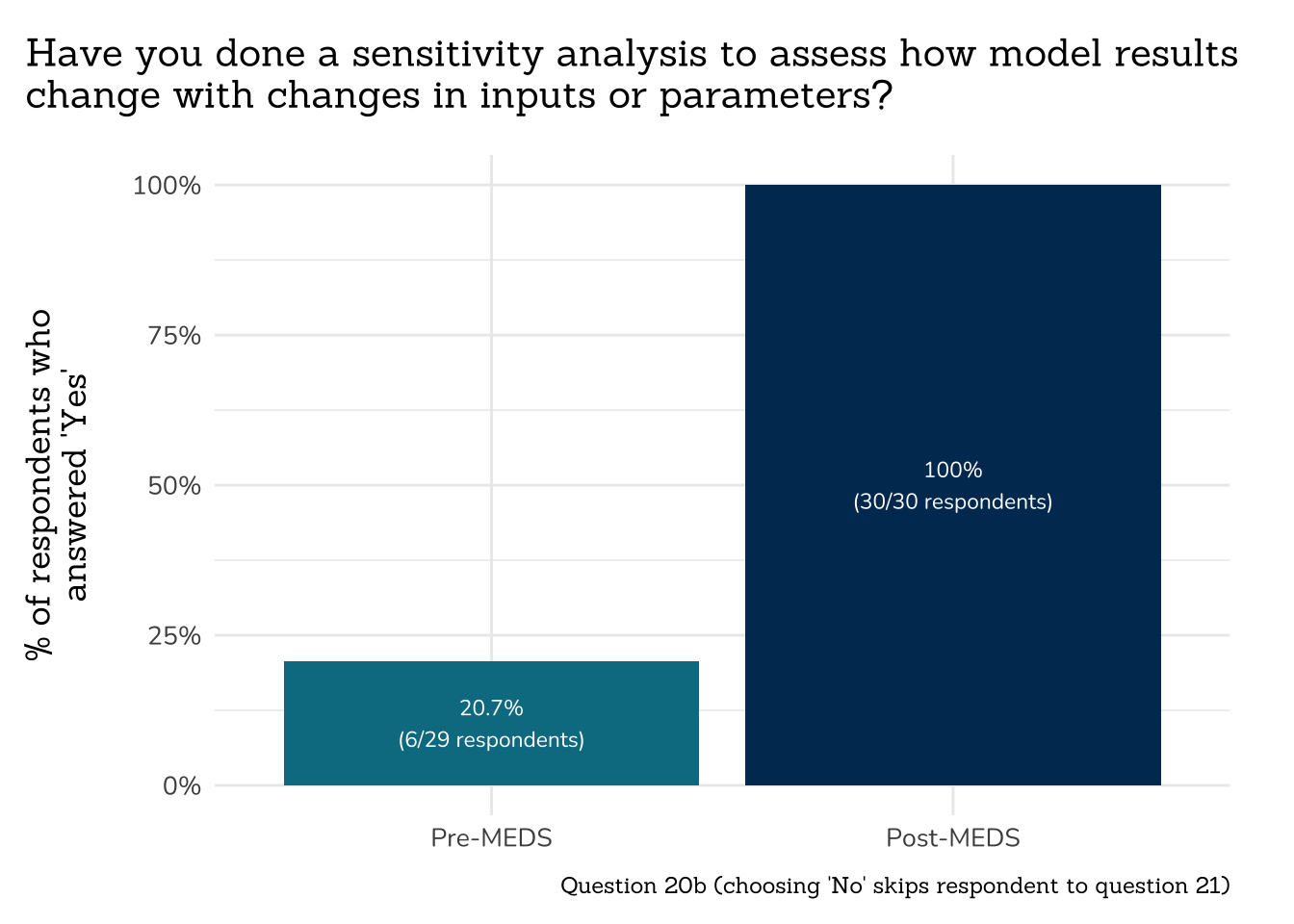
All Post-MEDS respondents were directed to answer Question 20b, as compared to the 16/29 respondents in the Pre-MEDS PLO Assessment.
Pre-MEDS: 16/29 student respondents (55.2%) answered “Yes” to Question 20a, and therefore were directed to answer Question 20b. Those who selected answered “No” (13 students) were jumped directly to Question 21.
Post-MEDS: 30/30 student respondents (100%) answered “Yes” to Question 20a, and therefore were directed to answer Question 20b.
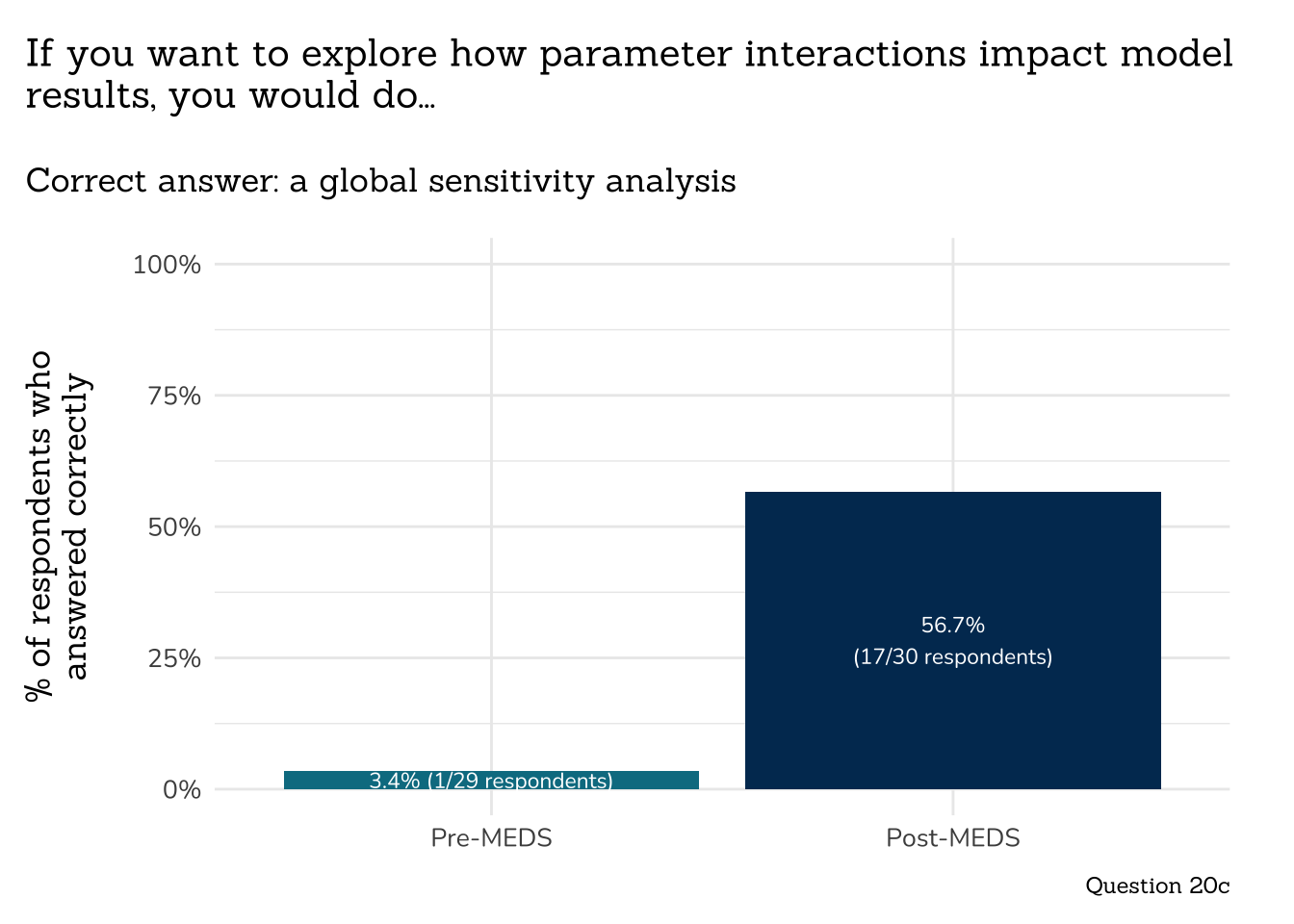
All Post-MEDS respondents were directed to answer Question 20c, as compared to the 6/16 respondents in the Pre-MEDS PLO Assessment.
Pre-MEDS: 6/16 student respondents (37.5%) answered “Yes” to Question 20b, and therefore were directed to answer Question 20c. Those who answered “No” (13 students) were jumped directly to Question 21.
Post-MEDS: 30/30 student respondents (100%) answered “Yes” to Question 20b, and therefore were directed to answer Question 20c.
Part 8: Geospatial Analysis & Remote Sensing
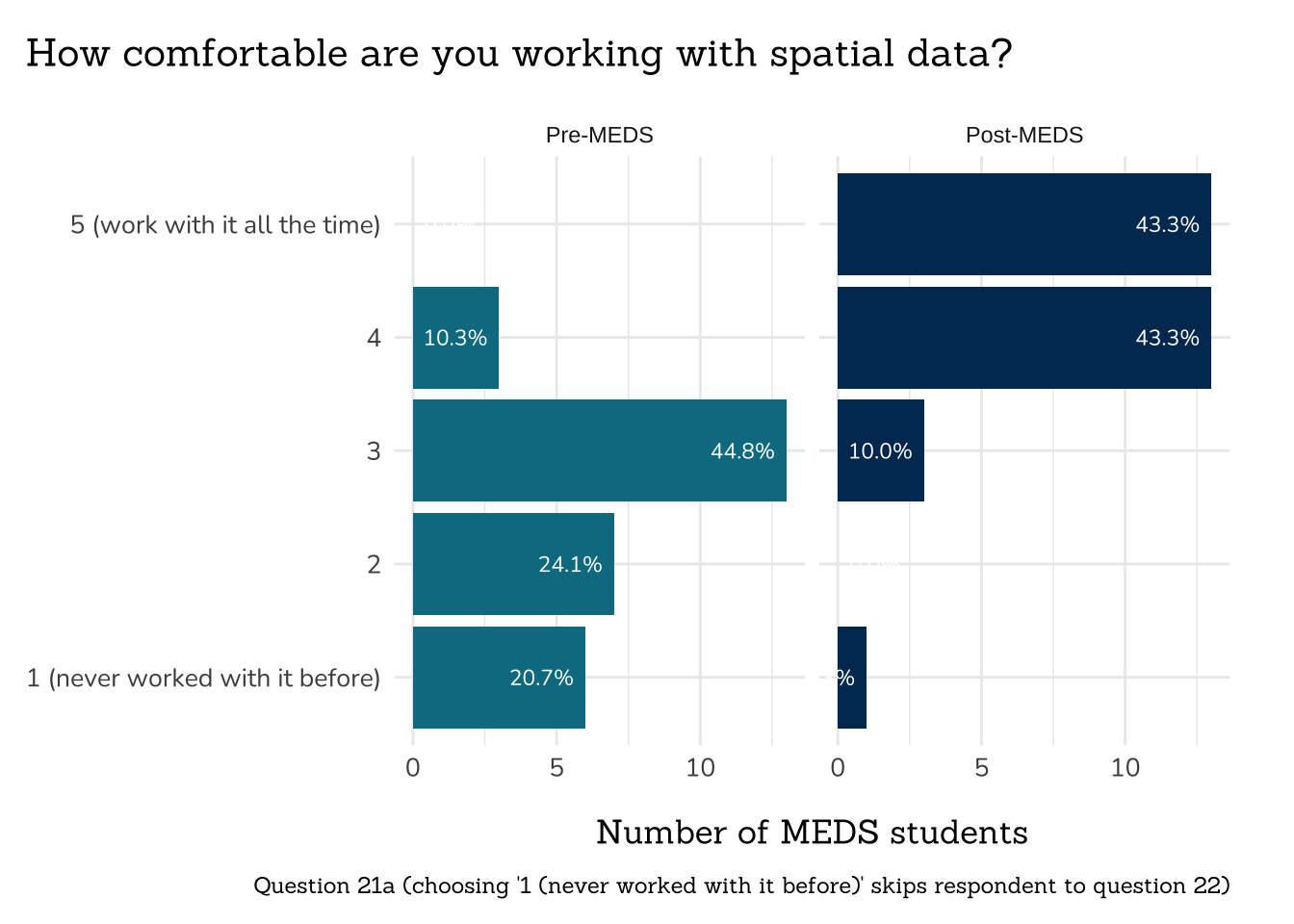
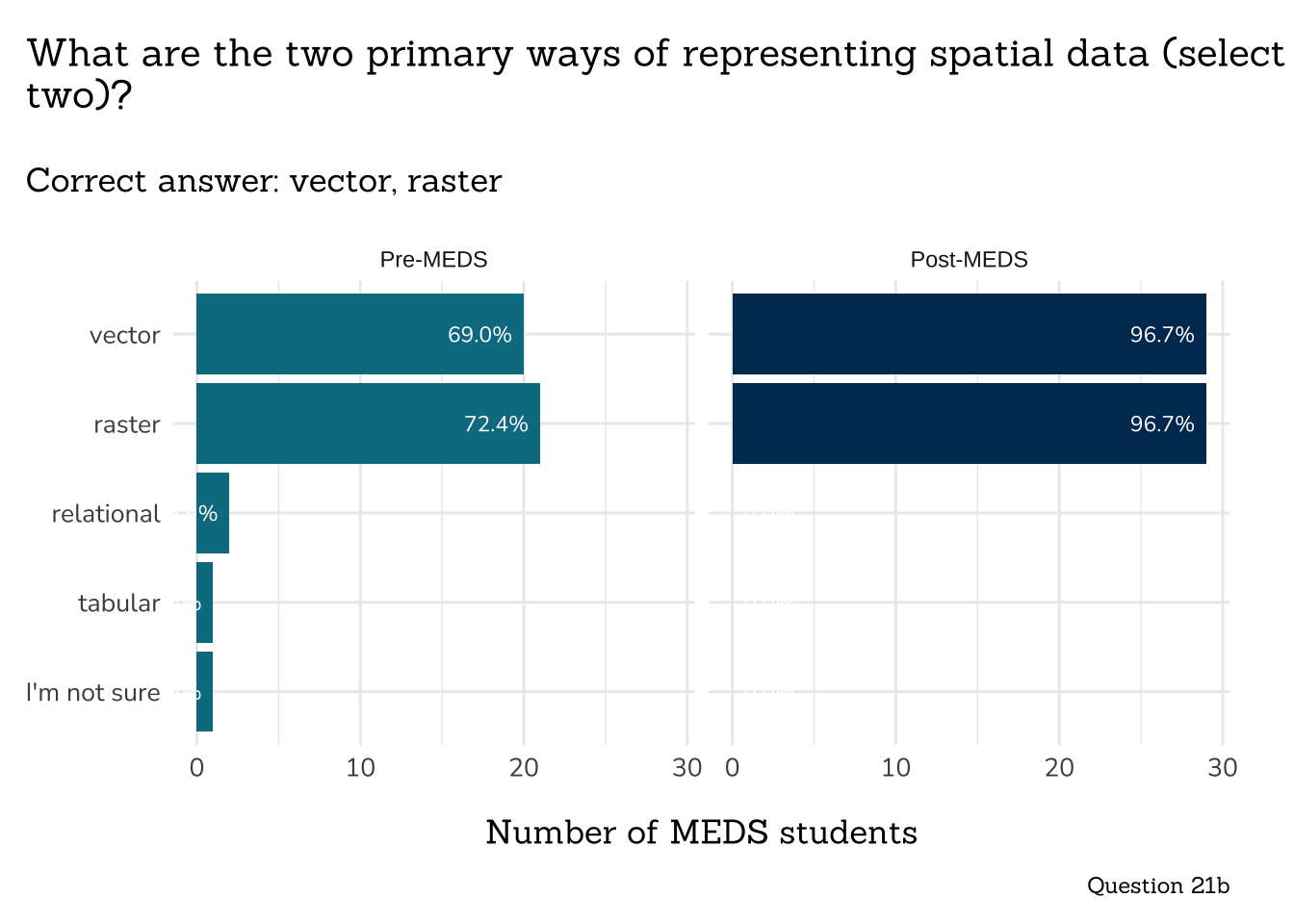
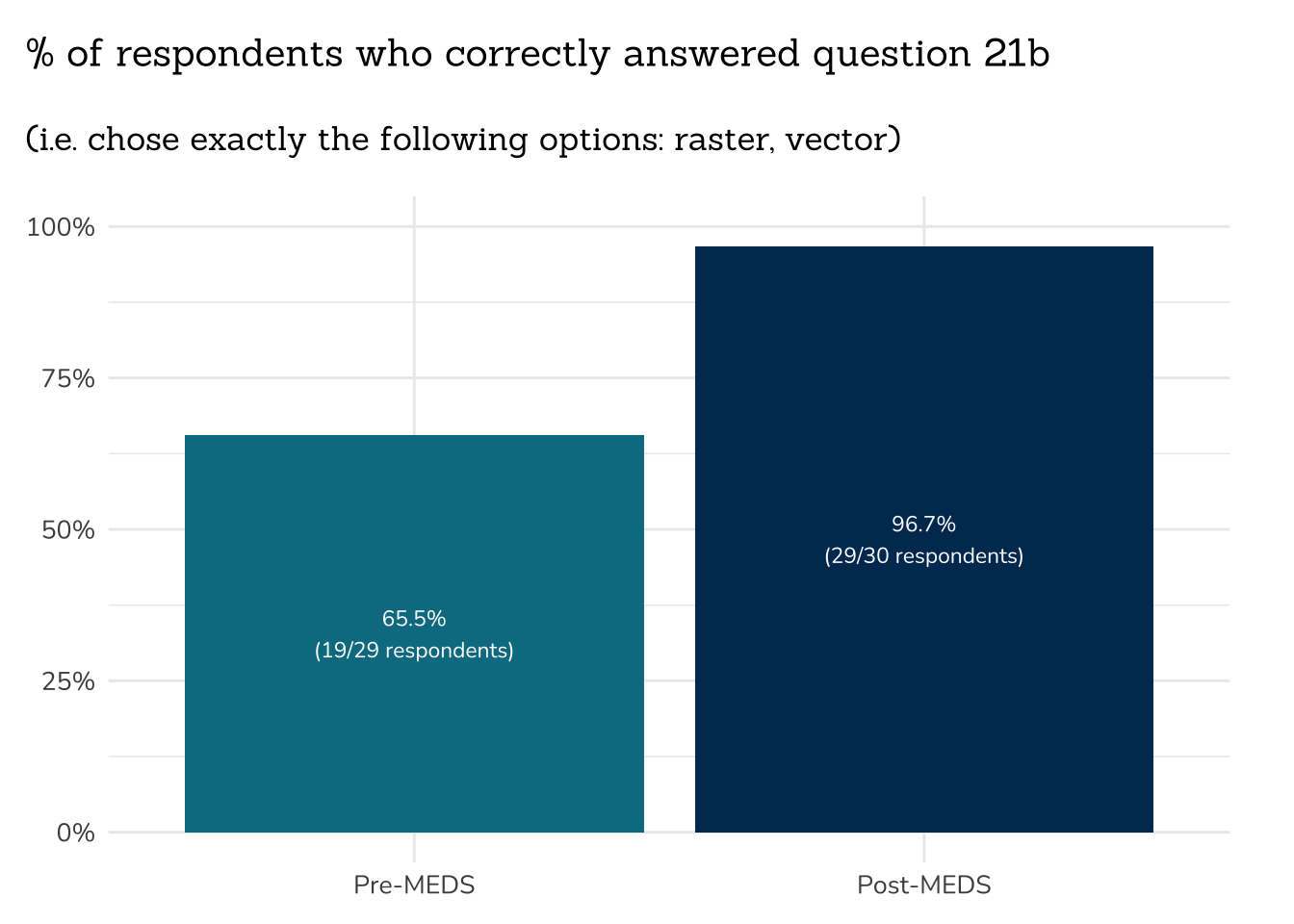
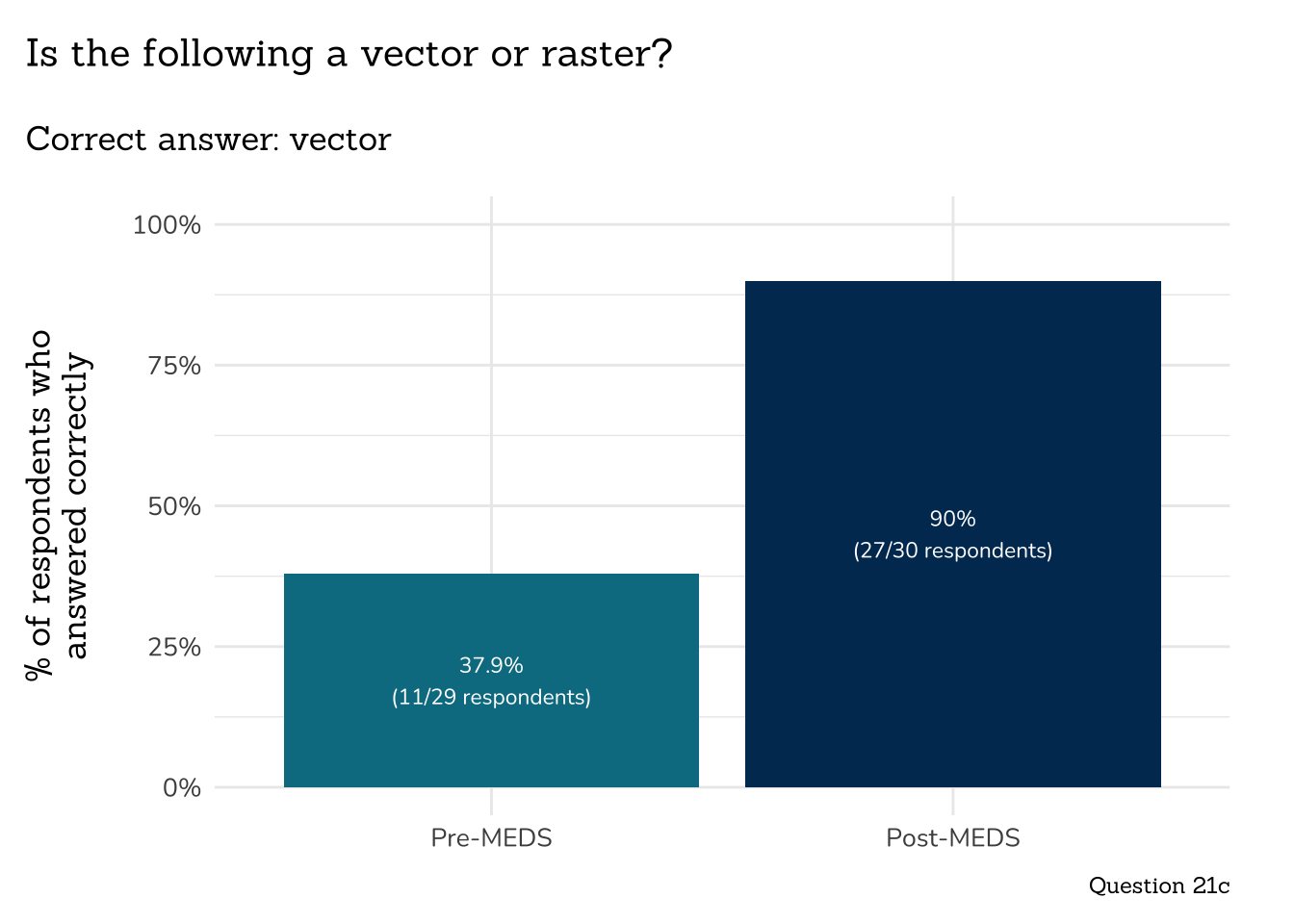
29/30 Post-MEDS respondents were directed to answer Questions 21b & 21c, as compared to the 23/29 respondents in the Pre-MEDS PLO assessment.
Pre-MEDS: 23/29 student respondents (79.3%) chose a familiarity level of 2 or greater, and therefore were directed to answer Questions 21b & 21c. Those who answered “1” (6 students) were jumped directly to Question 22.
Post-MEDS: 29/30 student respondents (96.7%) answered “Yes” to Question 21a, and therefore were directed to answer Questions 21b & 21c. Those who answered “1” (1 students) were jumped directly to Question 22.
Note
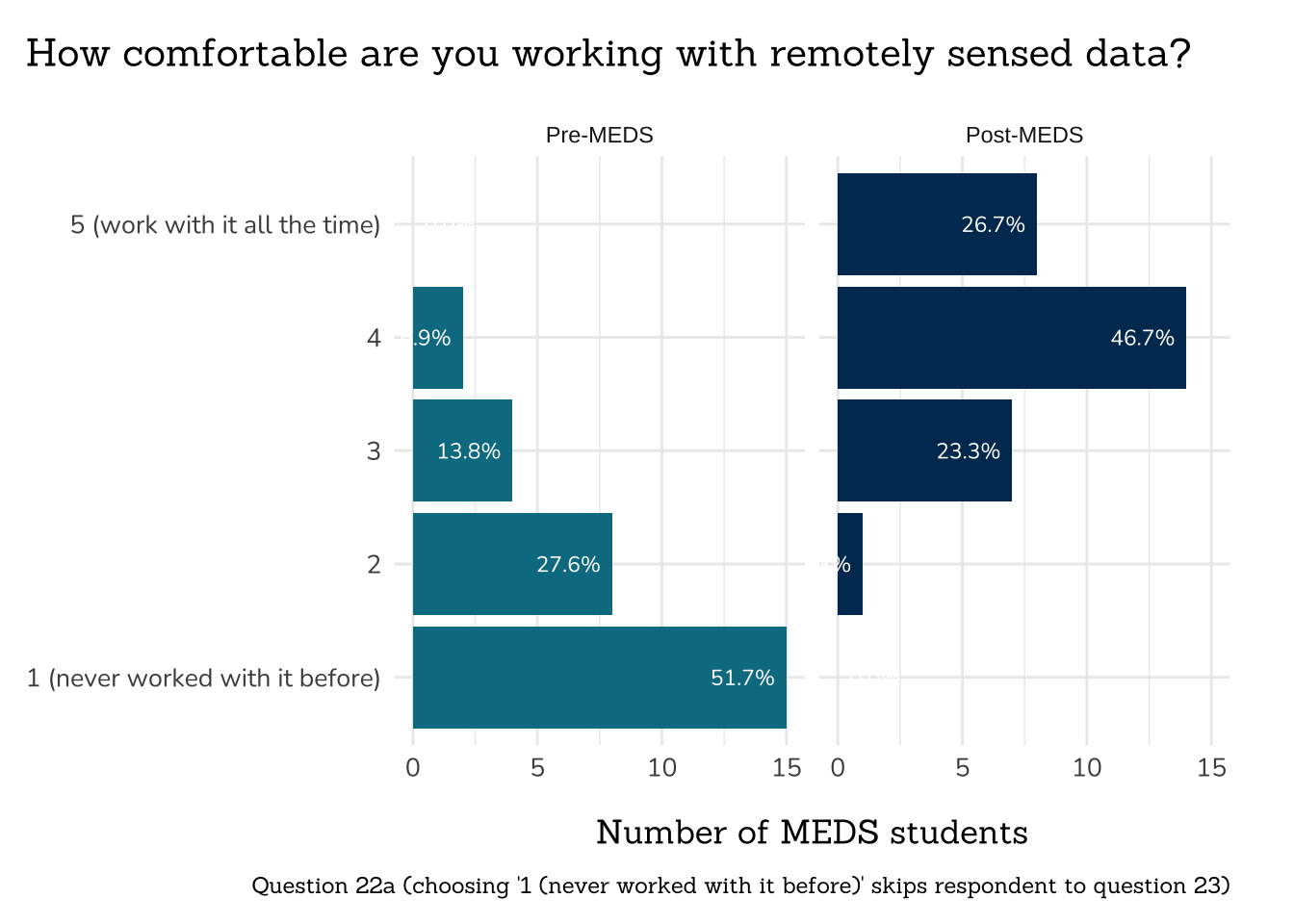
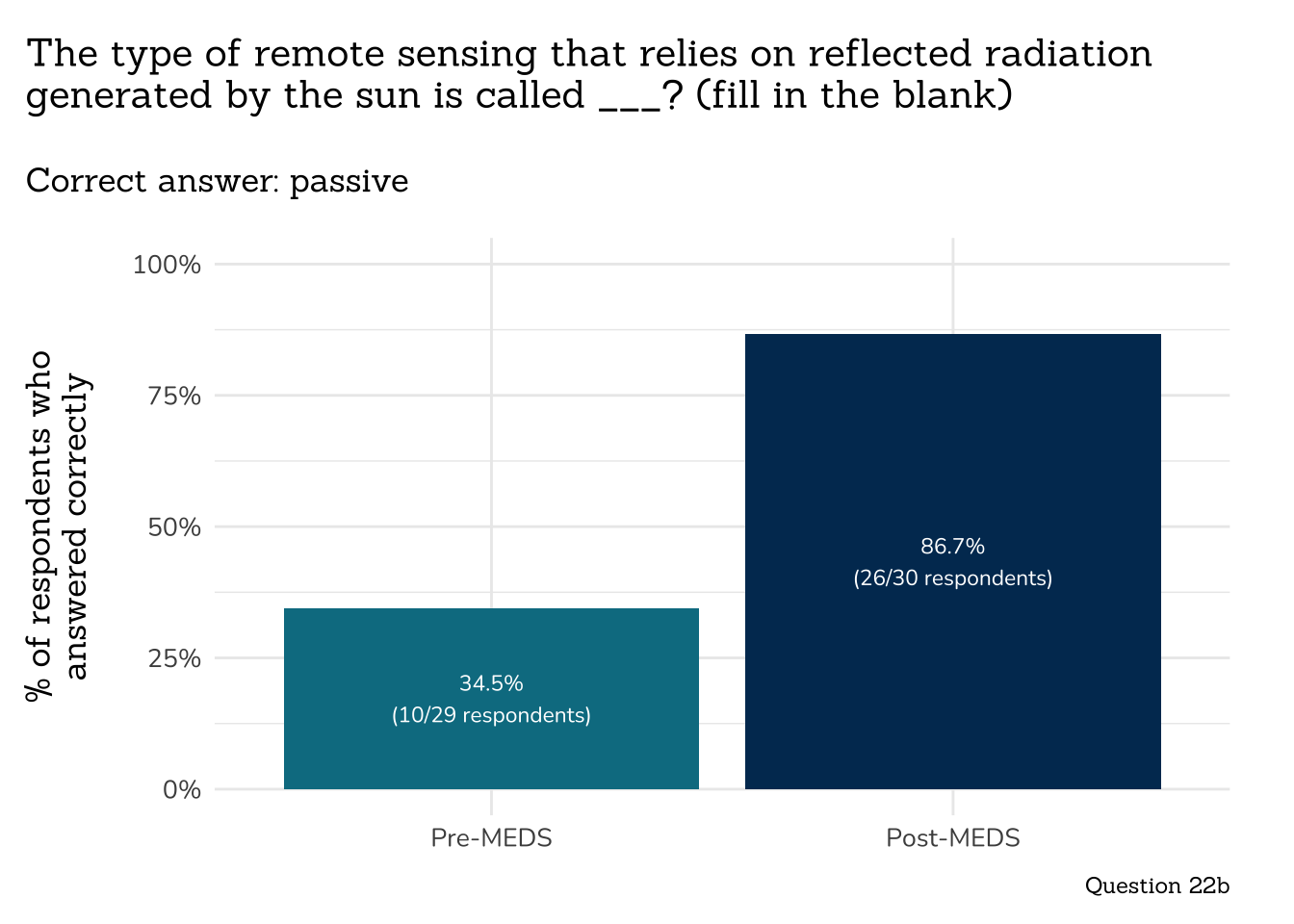
All Post-MEDS respondents were directed to answer Question 22b, as compared to the 14/29 respondents in the Pre-MEDS PLO assessment.
Pre-MEDS: 14/29 student respondents (48.3%) chose a familiarity level of 2 or greater, and therefore were directed to answer Question 22b. Those who answered “1” (15 students) were jumped directly to Question 23.
Post-MEDS: 30/30 student respondents (100%) chose a familiarity level of 2 or greater, and therefore were directed to answer Question 22b.
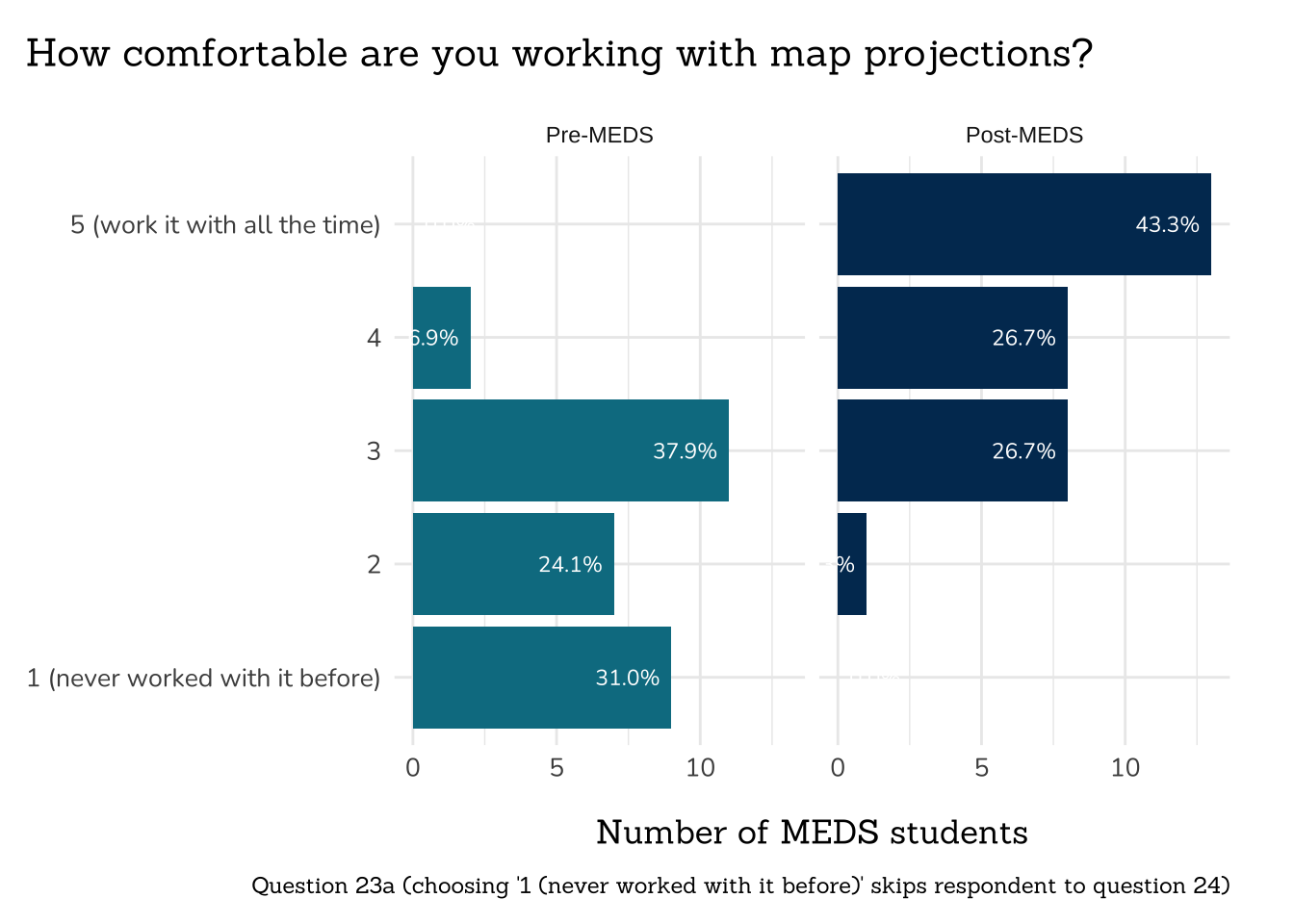
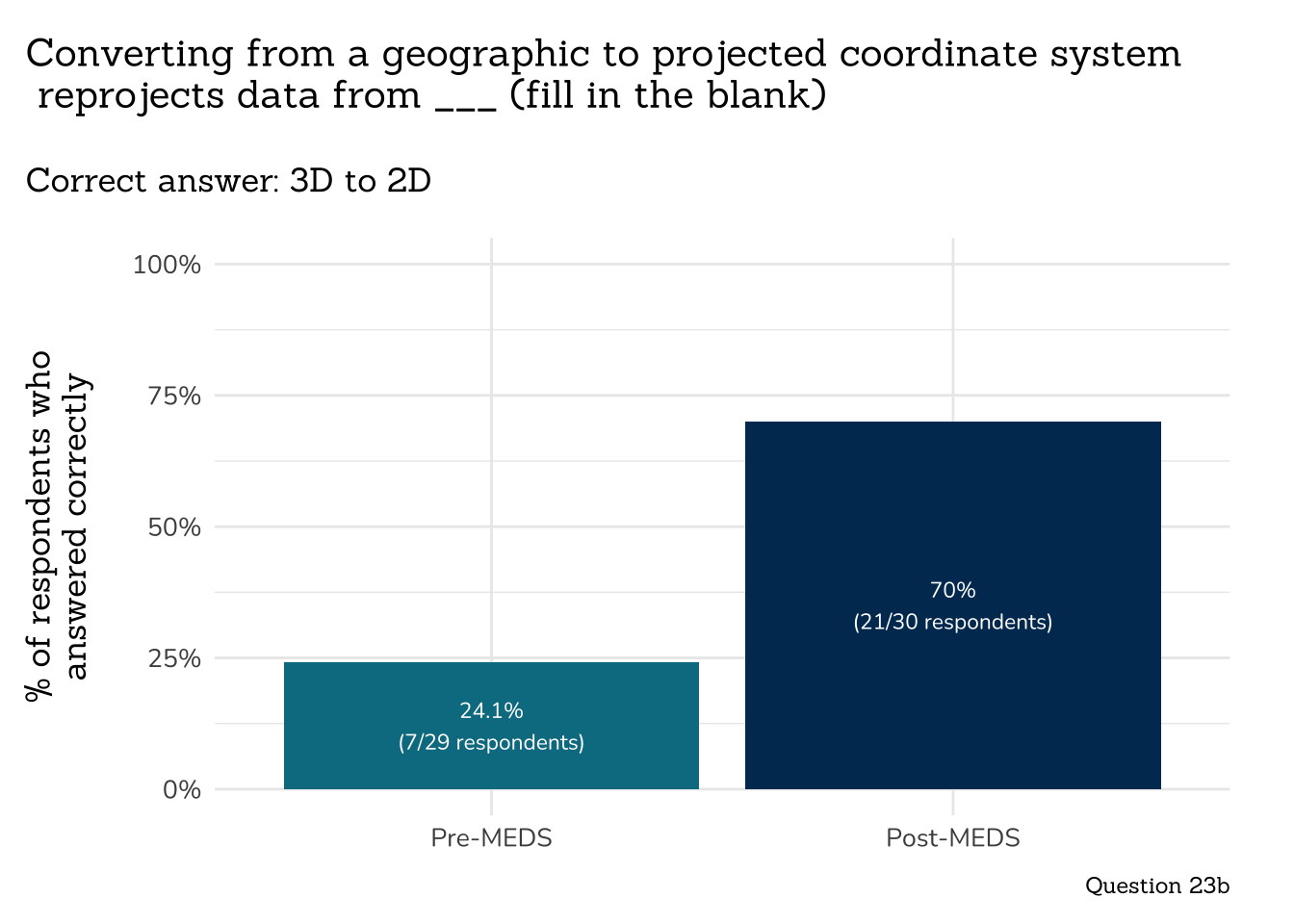
All Post-MEDS respondents were directed to answer Question 23b, as compared to the 20/29 respondents in the Pre-MEDS PLO assessment.
Pre-MEDS: 20/29 student respondents (69%) chose a familiarity level of 2 or greater, and therefore were directed to answer Question 23b. Those who answered “1” (15 students) were jumped directly to Question 24.
Post-MEDS: 30/30 student respondents (100%) chose a familiarity level of 2 or greater, and therefore were directed to answer Question 23b.
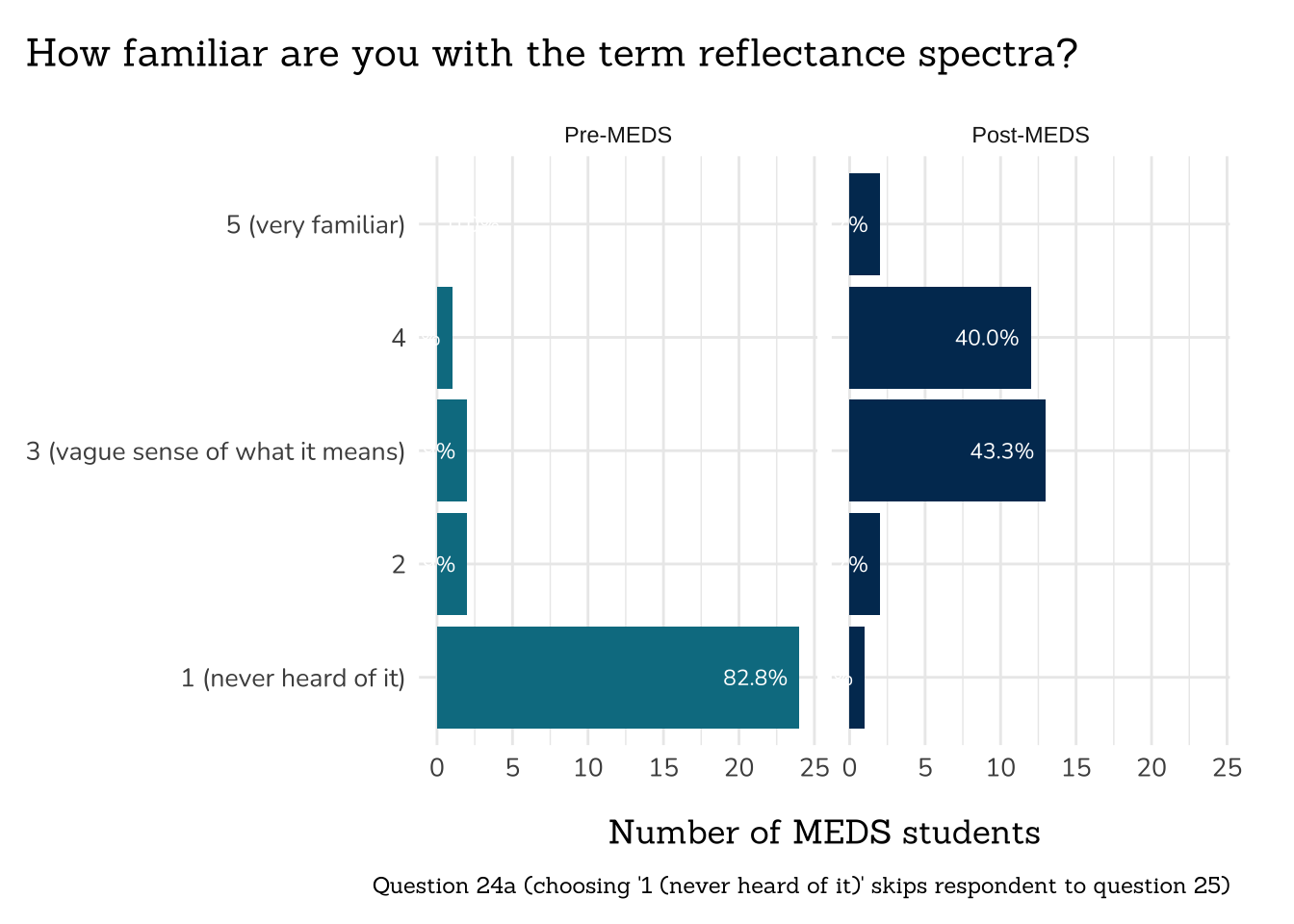
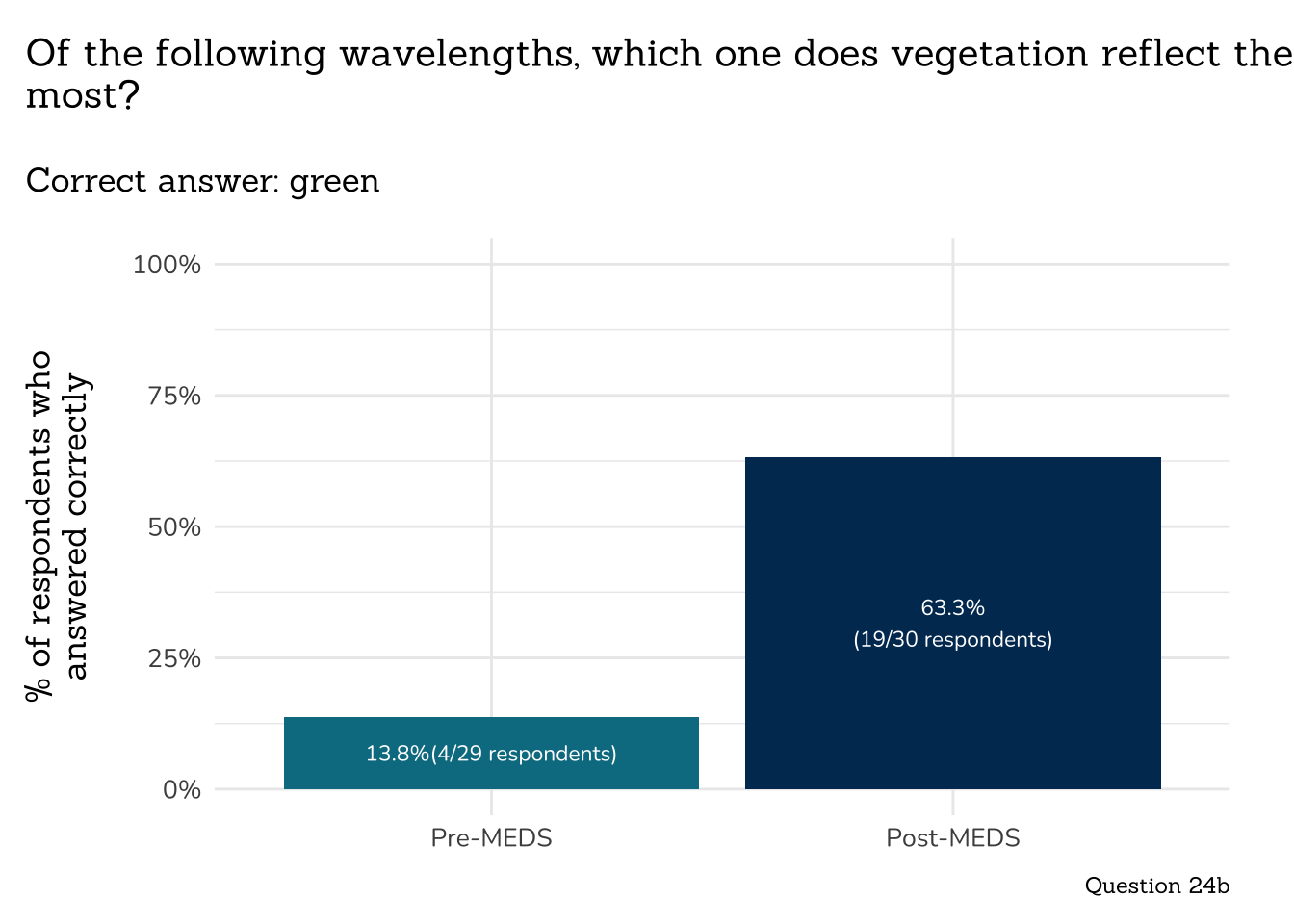
29/30 Post-MEDS respondents were directed to answer Question 24b, as compared to the 5/29 respondents in the Pre-MEDS PLO Assessment.
Pre-MEDS: 5/29 student respondents (17.2%) chose a familiarity level of 2 or greater, and therefore were directed to answer Question 24b. Those who answered “1” (24 students) were jumped directly to Question 25.
Post-MEDS: 29/30 student respondents (96.7%) chose a familiarity level of 2 or greater, and therefore were directed to answer Question 24b. Those who answered “1” (1 student) were jumped directly to Question 25.
Part 9: Machine Learning
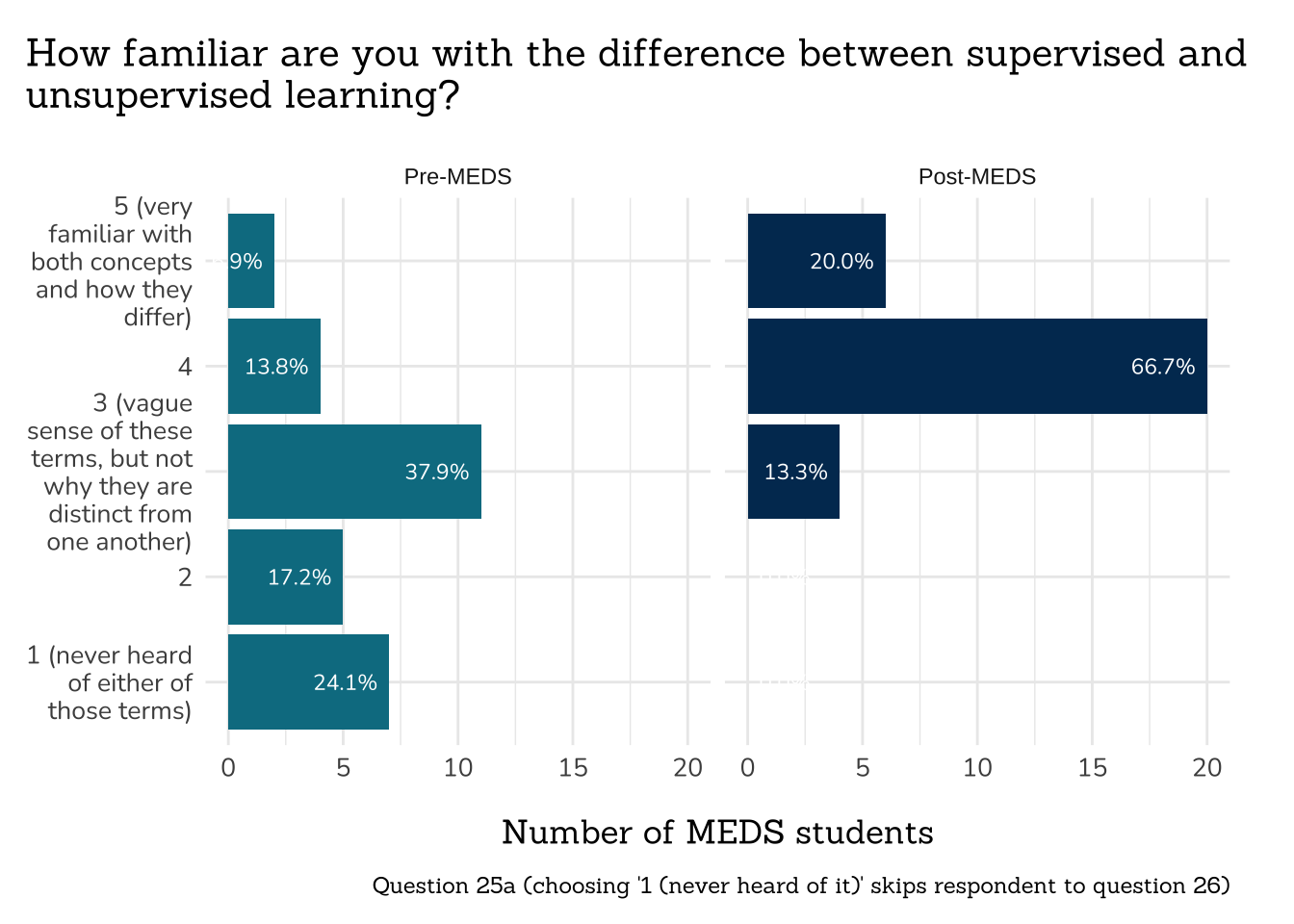
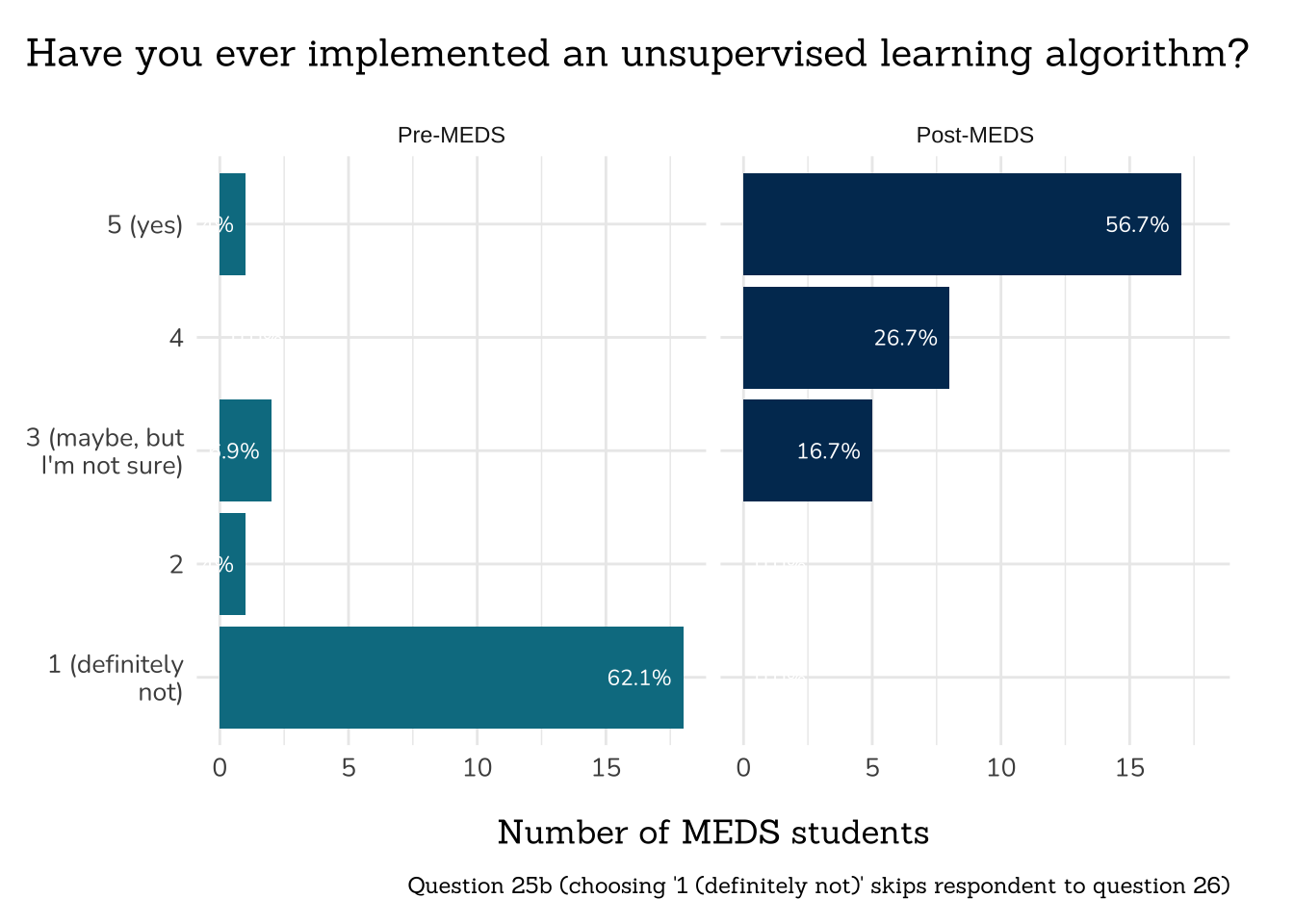
All Post-MEDS respondents were directed to answer Question 25b, as compared to the 22/29 respondents in the Pre-MEDS PLO assessment.
Pre-MEDS: 22/29 student respondents (75.9%) chose a familiarity level of 2 or greater, and therefore were directed to answer Question 25b. Those who answered “1” (7 students) were jumped directly to Question 26 – these non-responses are missing from the Question 25b plot, below, which is why percentages for the Pre-MEDS assessment do not add up to 100%.
Post-MEDS: 30/30 student respondents (100%) chose a familiarity level of 2 or greater, and therefore were directed to answer Question 25b.
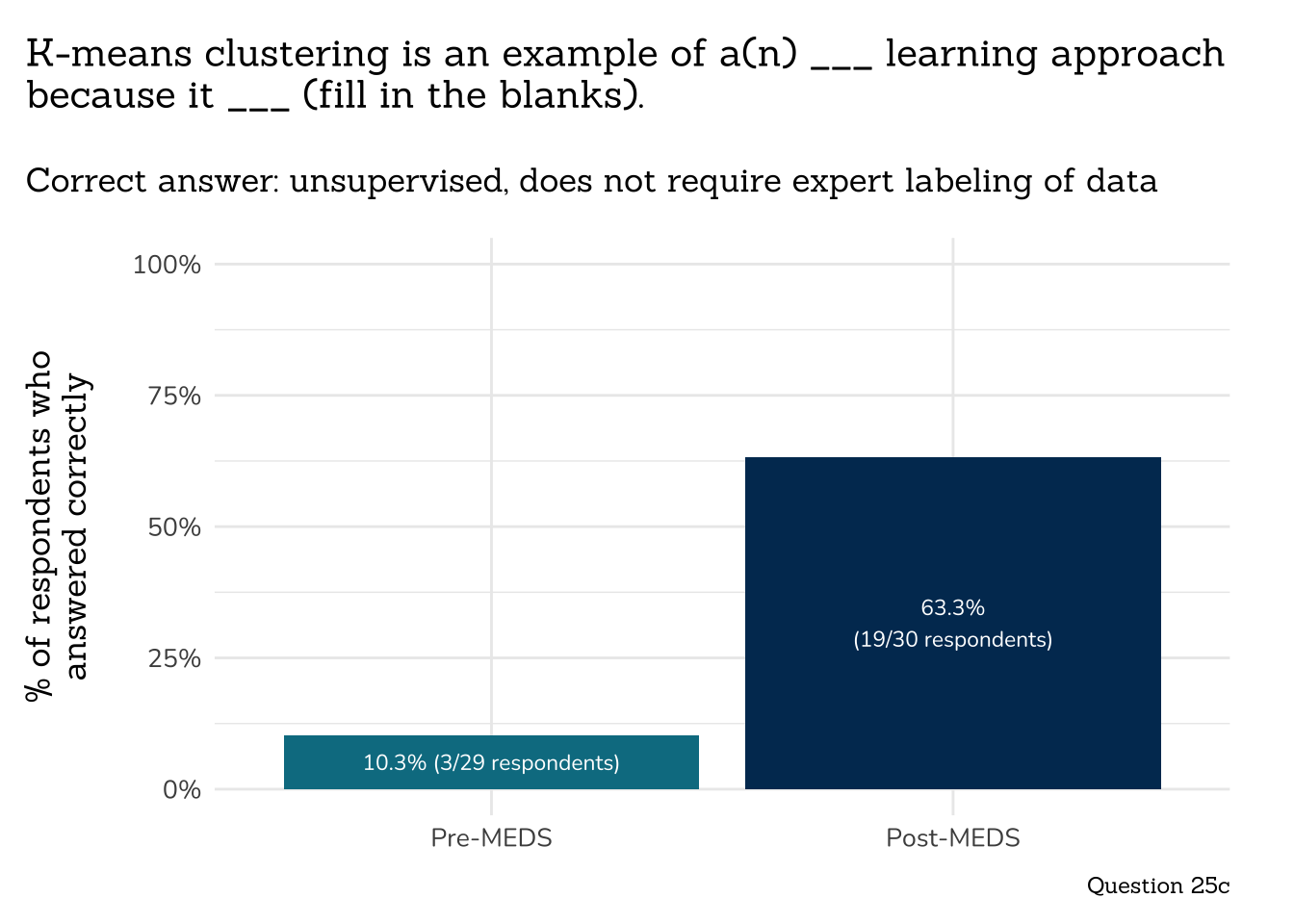
All Post-MEDS respondents were directed to answer Question 25c, as compared to the 11/29 respondents in the Pre-MEDS PLO assessment.
Pre-MEDS: 11/29 student respondents (37.9%) chose a familiarity level of 2 or greater, and therefore were directed to answer Question 25b. Those who answered “1” (18 students) were jumped directly to Question 26.
Post-MEDS: 30/30 student respondents (100%) chose a familiarity level of 2 or greater, and therefore were directed to answer Question 25c.
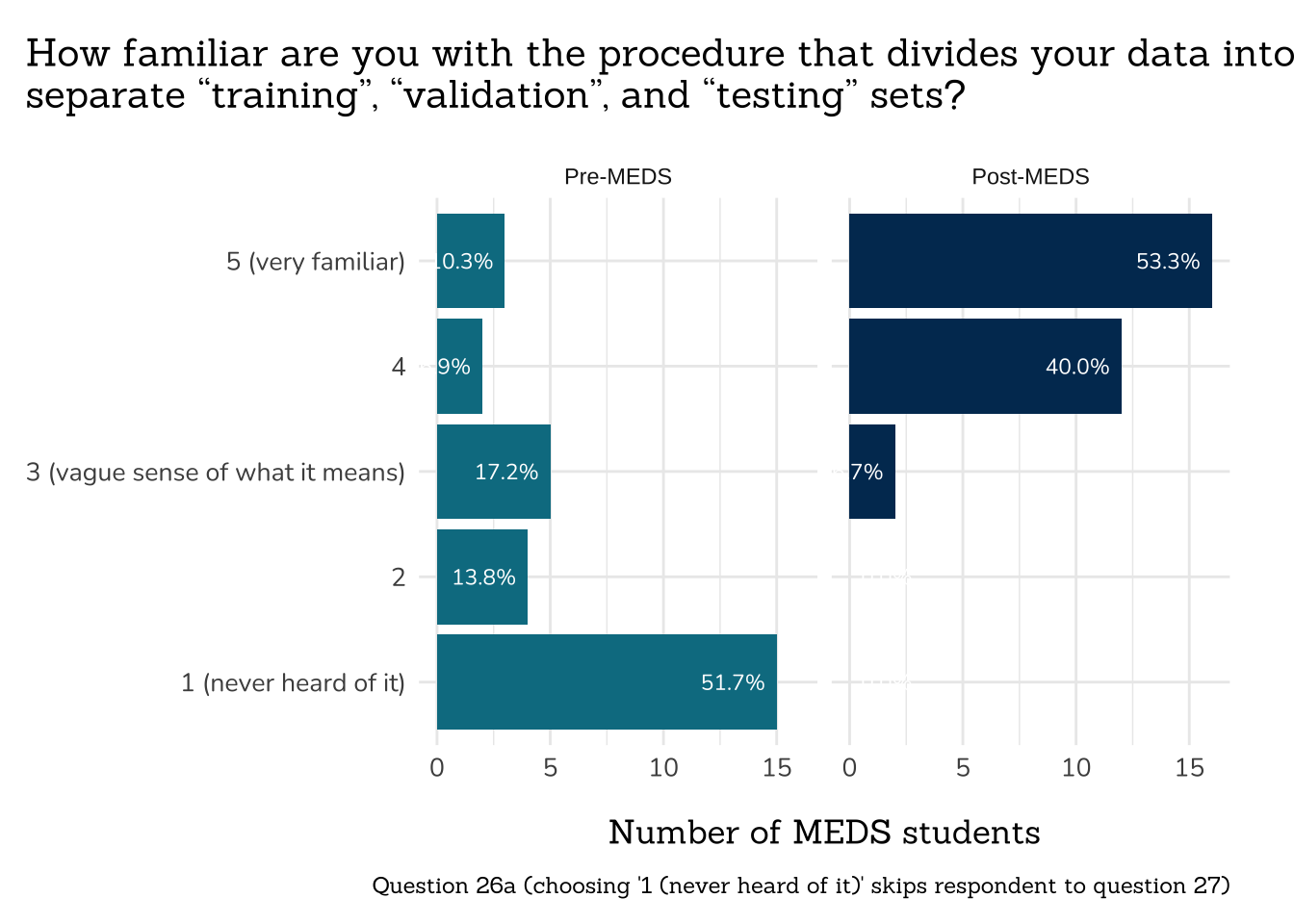
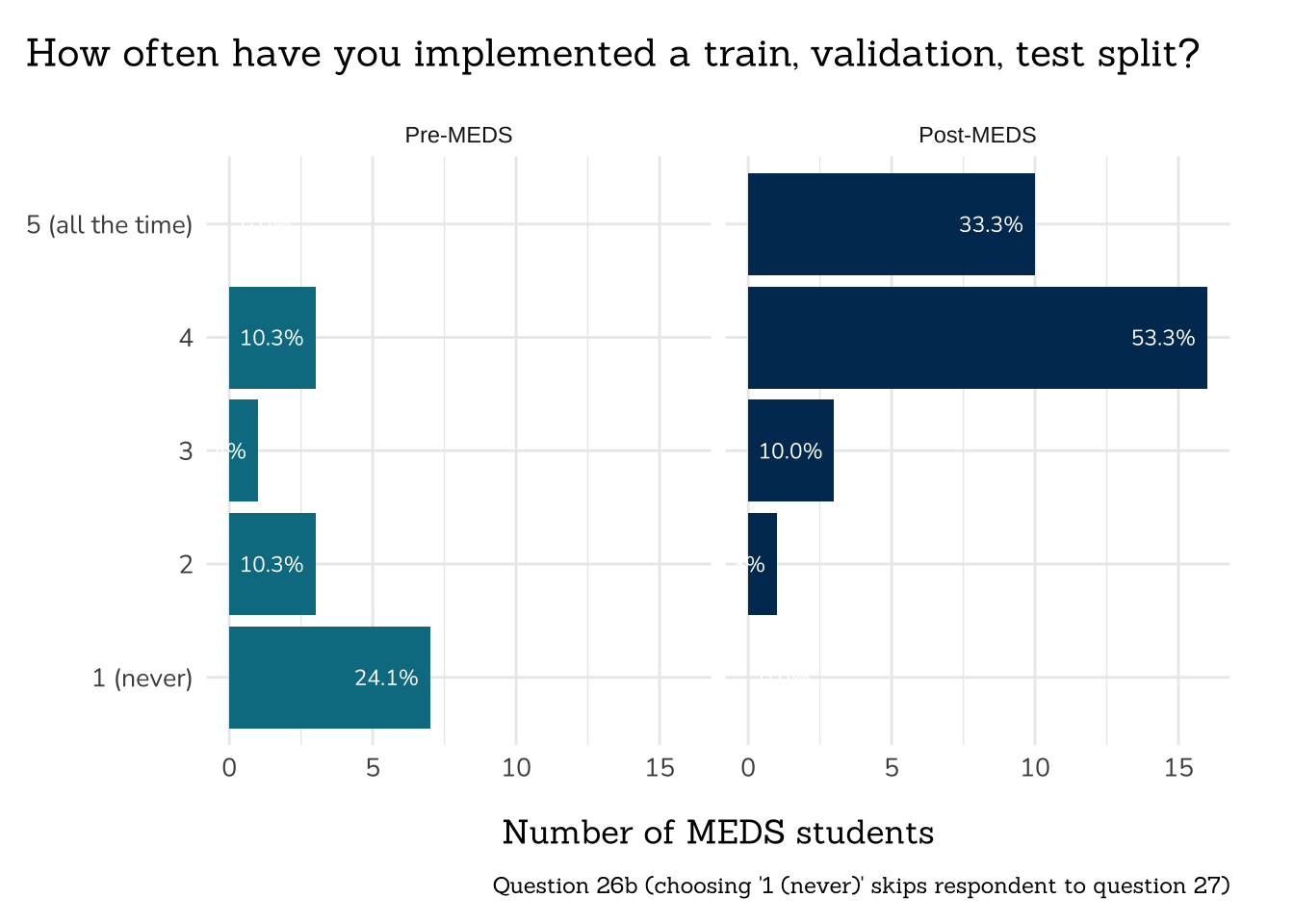
All Post-MEDS respondents were directed to answer Question 26b, as compared to the 14/29 respondents in the Pre-MEDS PLO assessment.
Pre-MEDS: 14/29 student respondents (48.3%) chose a familiarity level of 2 or greater, and therefore were directed to answer Question 26b. Those who answered “1” (15 students) were jumped directly to Question 27 – these non-responses are missing from the Question 26b plot, below, which is why percentages for the Pre-MEDS assessment do not add up to 100%.
Post-MEDS: 30/30 student respondents (100%) chose a familiarity level of 2 or greater, and therefore were directed to answer Question 26b.
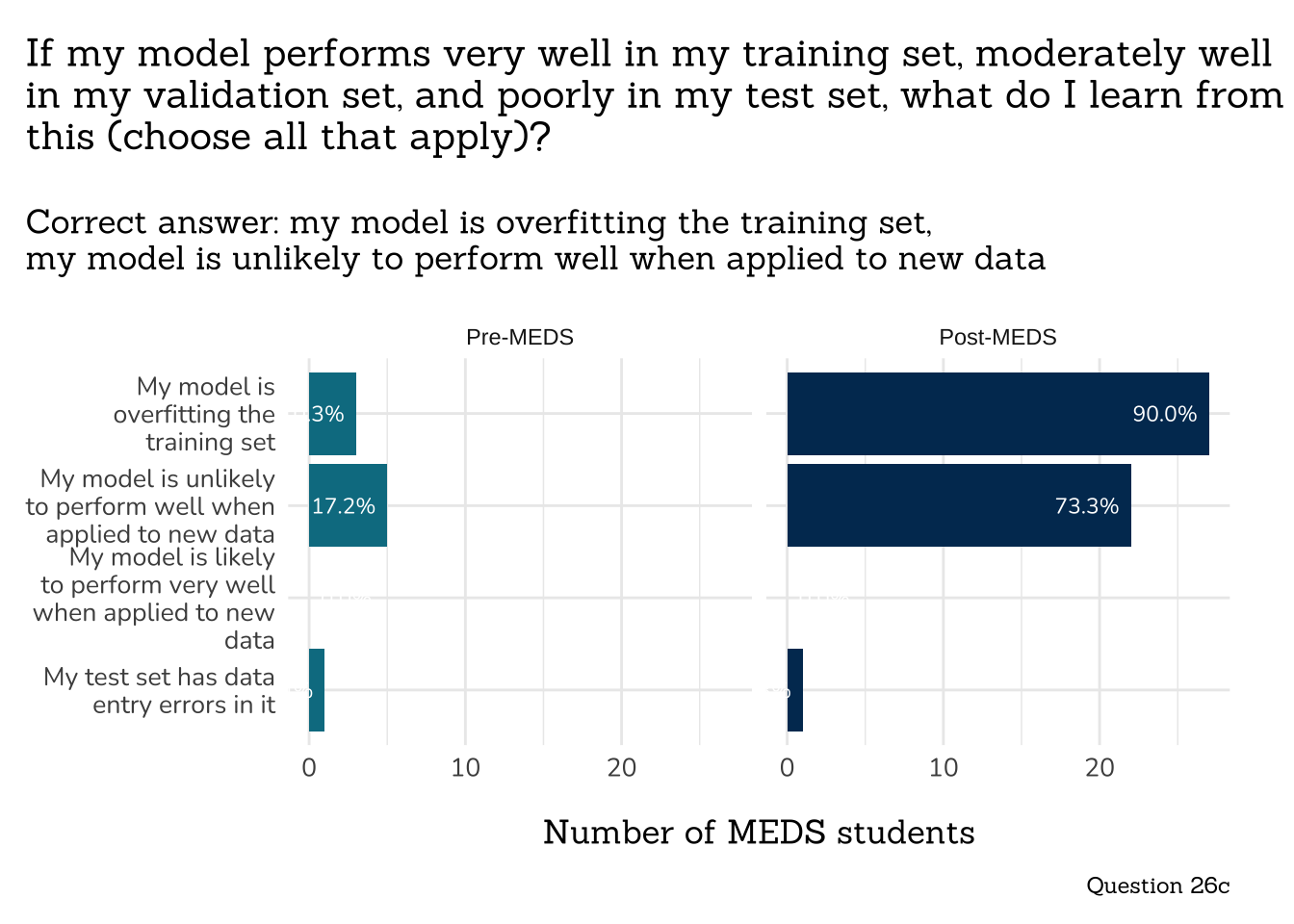
All Post-MEDS respondents were directed to answer Question 26c, as compared to the 7/29 respondents in the Pre-MEDS PLO assessment.
Pre-MEDS: 7/29 student respondents (24.1%) chose a familiarity level of 2 or greater, and therefore were directed to answer Question 26c. Those who answered “1” (7 students) were jumped directly to Question 27 – these non-responses are missing from the Question 26c plot, below, which is why percentages for the Pre-MEDS assessment do not add up to 100%.
Post-MEDS: 30/30 student respondents (100%) chose a familiarity level of 2 or greater, and therefore were directed to answer Question 26c.
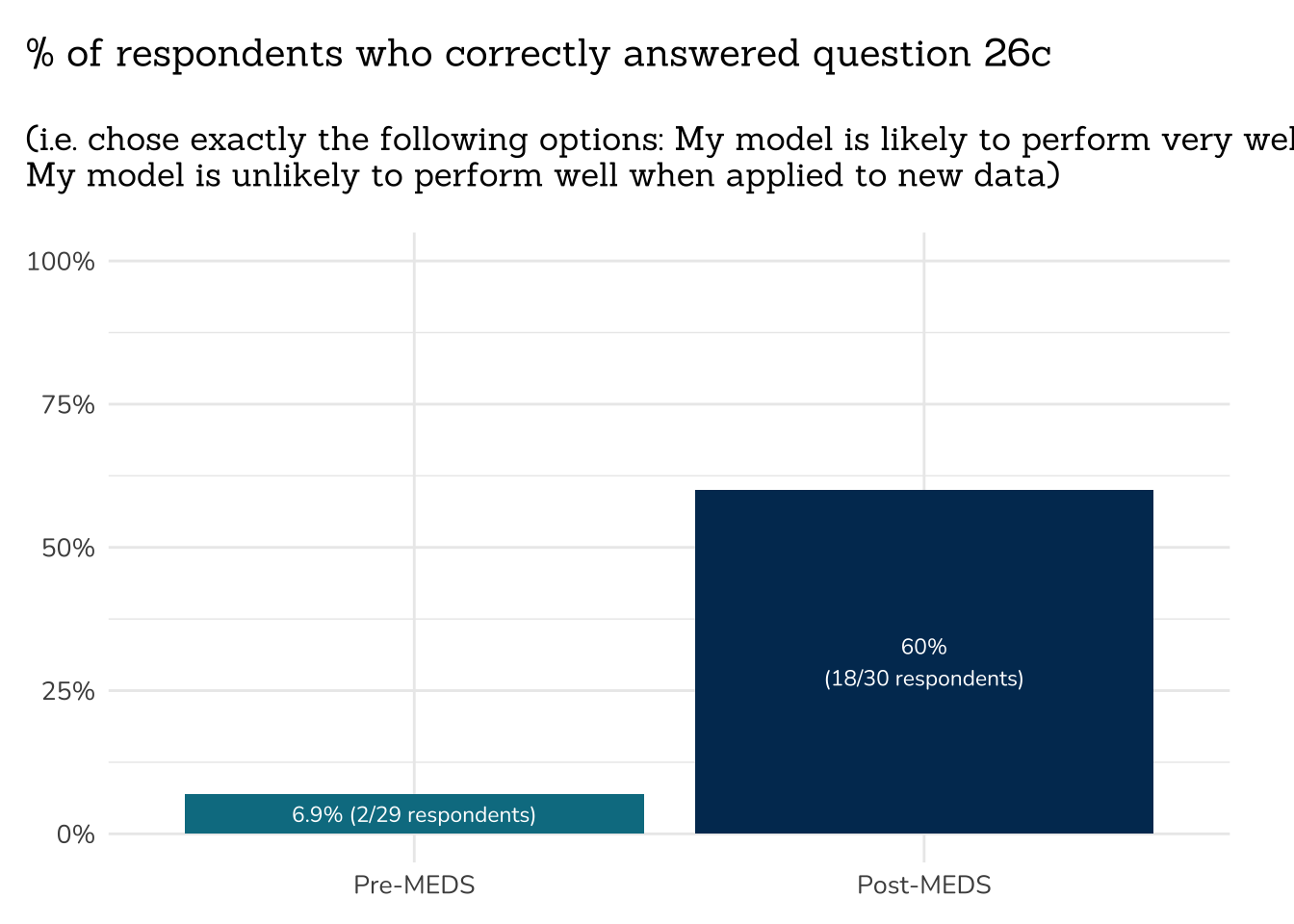
The percentage of respondents who provided a fully correct answer to Queston 26c increased from Pre- to Post-MEDS PLO assessments
Only students who chose 2 or greater in Question 26b were directed to answer Question 26c. A fully correct answer means choosing exactly the following options: My model is overfitting the training set, My model is unlikely to perform well when applied to new data.
Part 10: Environmental Justice
Part 11: Data Viz & Communication
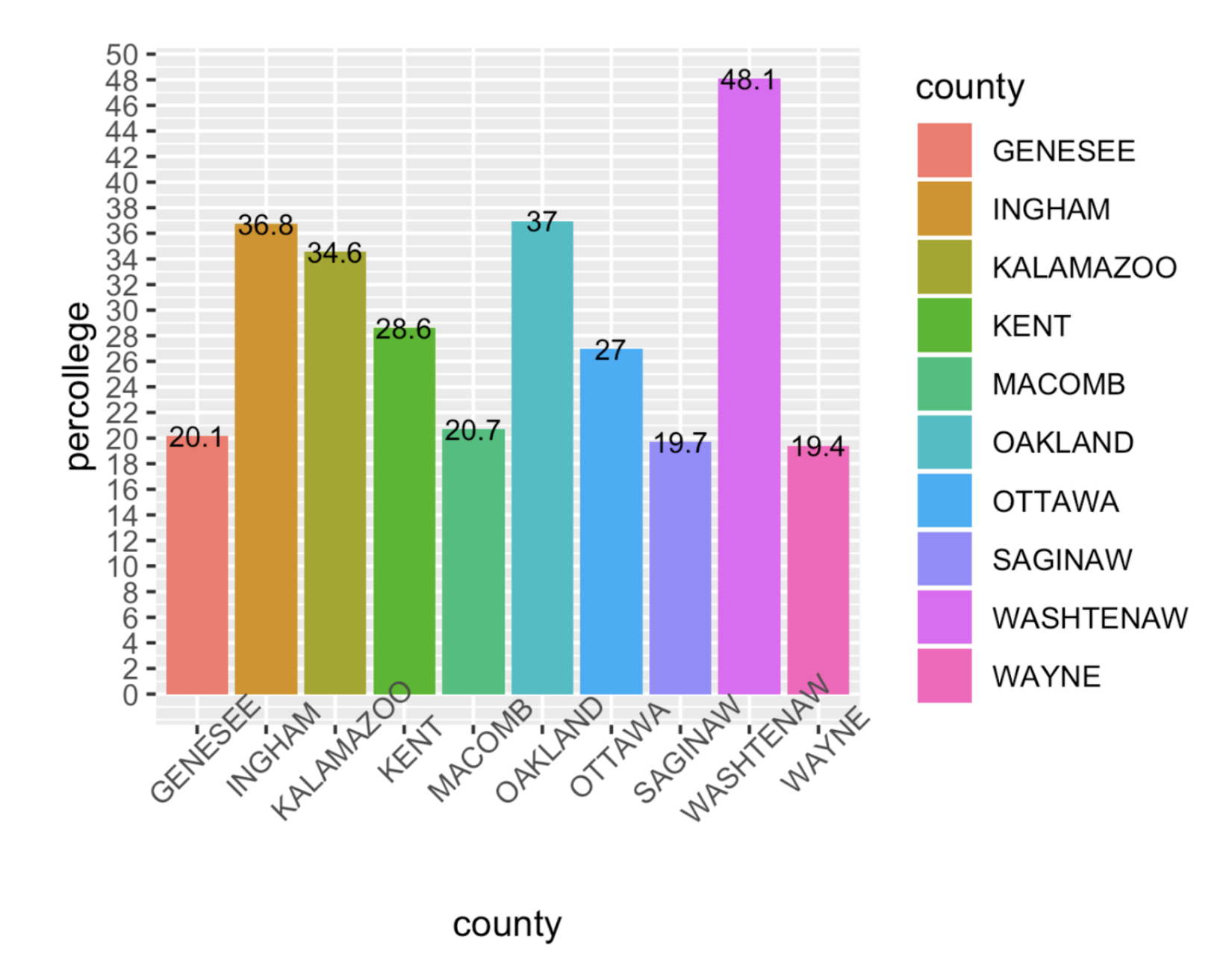
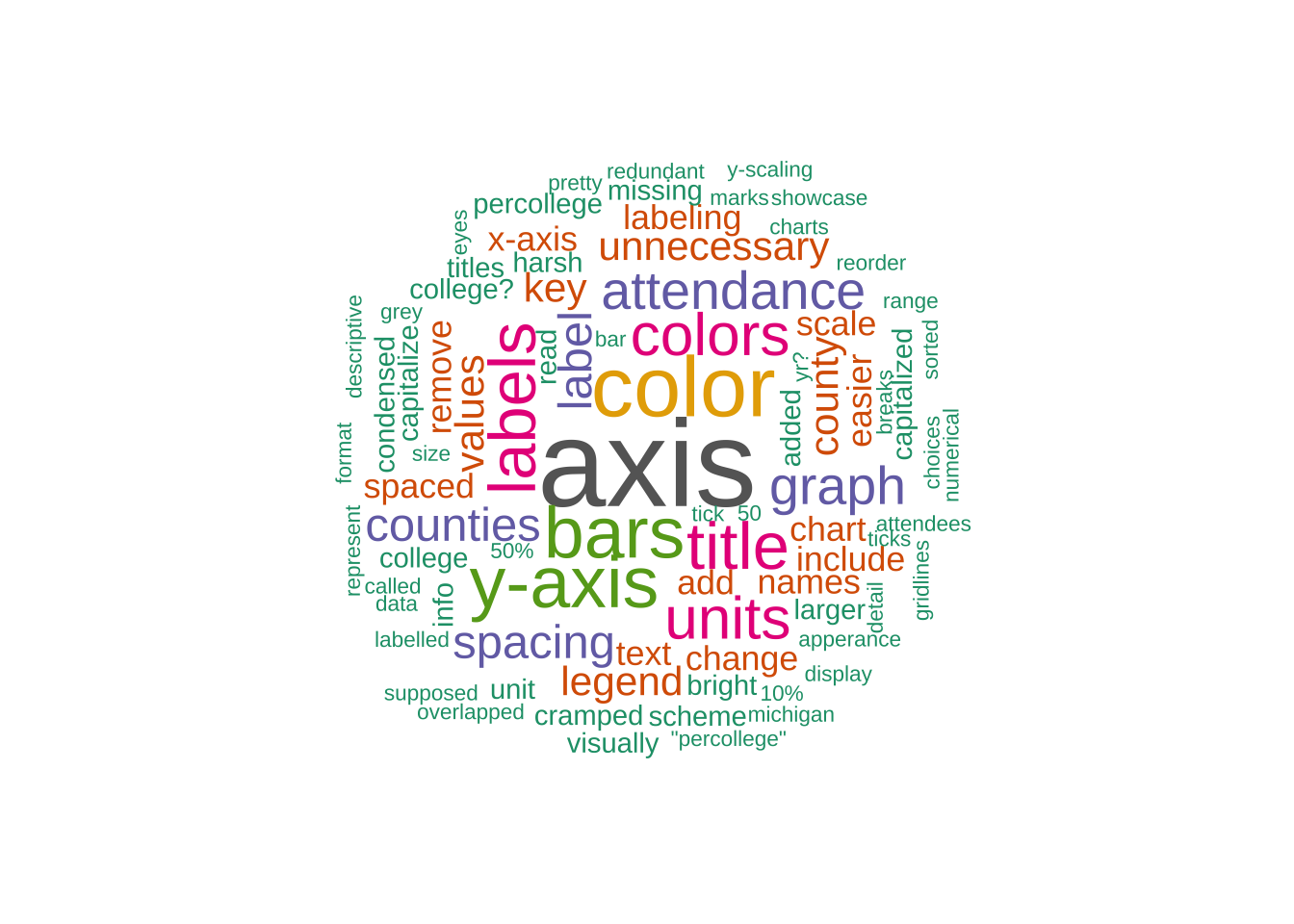
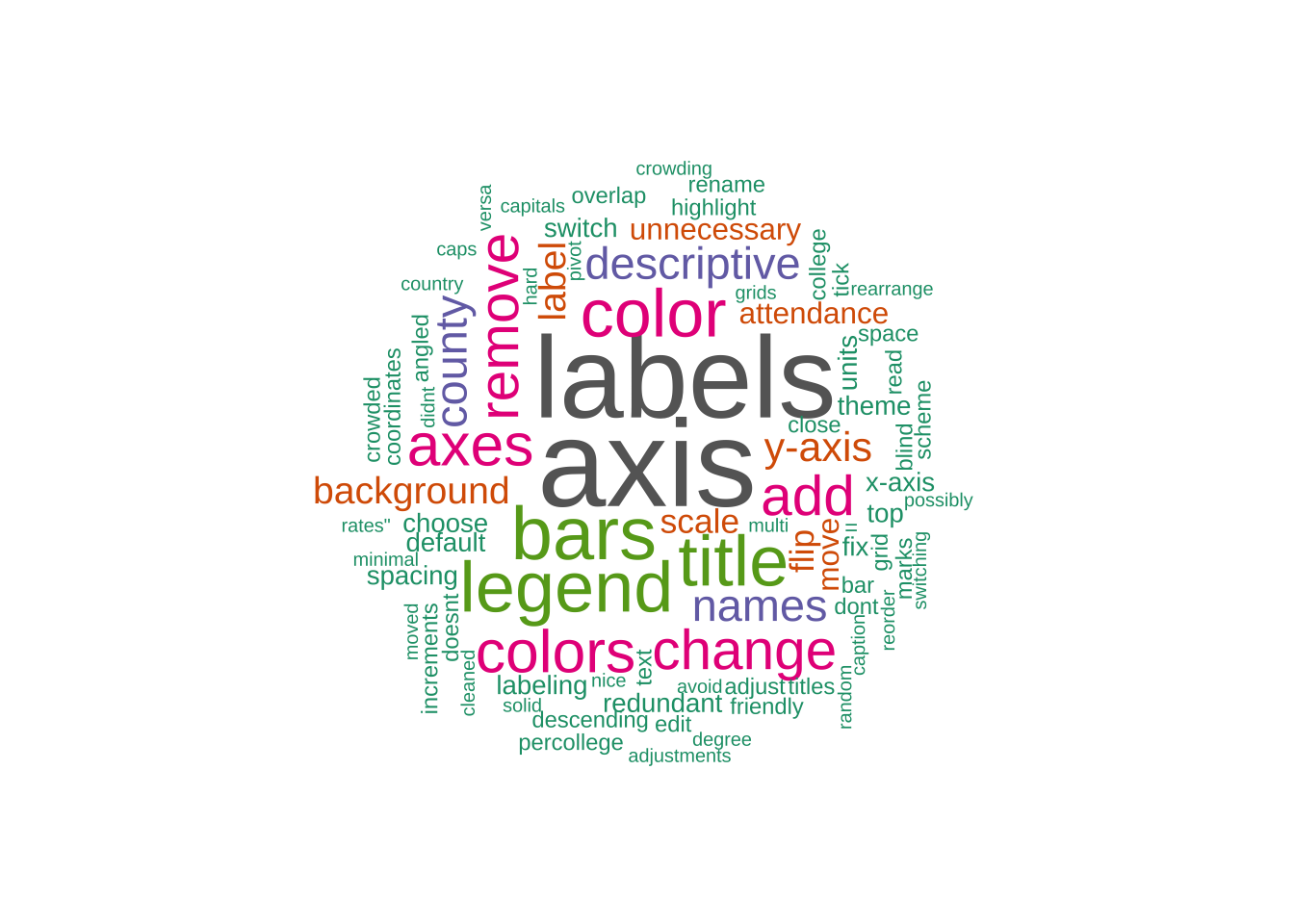
Identify 4 areas for improvement in the following data visualization that shows information about Michigan counties with highest college attendance (Question 30).
Wordcloud of most frequently occurring words used to describe suggested improvements to the above data visualization (Question 30)
Pre-MEDS
Post-MEDS
Question 30 raw responses
Responses as they were recorded are included in the tables, below:
---title: "MEDS Class of 2025"subtitle: "Program Learning Outcome (PLO) #1 Assessment - Core Knowledge"author: "Sam Shanny-Csik & Jamie Montgomery"date: August 13, 2024date-modified: last-modifiedformat: html: toc: true toc-location: left code-tools: source: true toggle: false theme: - ../styles.scss mainfont: Nunitoexecute: eval: true echo: false message: false warning: falseeditor_options: chunk_output_type: console---```{r}#..........................load packages.........................library(googlesheets4)library(tidyverse)library(janitor)library(showtext)library(ggtext)library(DT)library(tidytext)library(wordcloud)library(scales)#........................import functions........................source(here::here("functions.R"))#..........................import data...........................meds2025_before <-read_sheet("https://docs.google.com/spreadsheets/d/1E3WbMZuOl33sUgbJcPmrqMQbCp3-AsmRAjuxdNXk6oM/edit?gid=1486409728#gid=1486409728")meds2025_after <-read_sheet("https://docs.google.com/spreadsheets/d/1sEetdIXKXQNhVShJHddZd2tnS1QP5-uw0Sk8x3qd7Is/edit?usp=sharing")#...........................clean data...........................meds2025_before_clean <-clean_PLO_data(meds2025_before) |>mutate(timepoint =rep("Pre-MEDS"))meds2025_after_clean <-clean_PLO_data(meds2025_after) |>mutate(timepoint =rep("Post-MEDS"))#...............combine pre- and post-MEDS results...............both_timepoints_clean <-rbind(meds2025_before_clean, meds2025_after_clean) |>mutate(timepoint =fct_relevel(timepoint, c("Pre-MEDS", "Post-MEDS")))#..................number of survey respondents..................=pre_meds_num_respondents <-nrow(meds2025_before_clean)post_meds_num_respondents <-nrow(meds2025_after_clean)#......................import Google fonts.......................sysfonts::font_add_google(name ="Sanchez", family ="sanchez")sysfonts::font_add_google(name ="Nunito", family ="nunito")# automatically use showtext to render text for future devices ----showtext::showtext_auto()#......................create color palette......................meds_pal <-c("Pre-MEDS"="#047C91","Post-MEDS"="#003660")```# **Summary**{{< include /summary-text/class2025/summary.qmd >}}```{r overall-scores}#| fig-align: center#........................Pre-MEDS scores.........................scores_before <- meds2025_before_clean |> select(sc0) mean_score_before <- mean(scores_before$sc0)median_score_before <- median(scores_before$sc0)#........................Post-MEDS scores........................scores_after <- meds2025_after_clean |> select(sc0)mean_score_after <- mean(scores_after$sc0)median_score_after <- median(scores_after$sc0)#..........................combined plot.........................ggplot(both_timepoints_clean, aes(x = sc0)) + geom_histogram(aes(fill = timepoint), color = "white", binwidth = 1, position = "identity", alpha = 0.8) + # add "Pre-MEDS" median score ---- geom_vline(xintercept = median_score_before, linetype = "dashed", color = "#047C91") + annotate(geom = "segment", x = 7, y = 8, xend = median_score_before, yend = 7.5, arrow = arrow(length = unit(3, "mm")), color = "#047C91") + annotate(geom = "label", x = 9.8, y = 8, label = paste0("Median Score = ", median_score_before), hjust = "right", color = "#047C91") + # add "Post-MEDS" median score ---- geom_vline(xintercept = median_score_after, linetype = "dashed", color = "#003660") + annotate(geom = "segment", x = 13, y = 8, xend = median_score_after, yend = 7.5, arrow = arrow(length = unit(3, "mm")), color = "#003660") + annotate(geom = "label", x = 14, y = 8, label = paste0("Median Score = ", median_score_after), hjust = "center", color = "#003660") + # make pretty ---- coord_cartesian(clip = "off") + scale_fill_manual(values = meds_pal) + scale_x_continuous(breaks = seq(1, 14, 1)) + labs(x = "Score", y = "Number of MEDS students", title = "Distribution of scores", caption = "Out of 14 available points") + meds_theme()```# **Individual Questions**## **Part 1: OS and data/document storage**```{r Q1-what-OS}##~~~~~~~~~~~~~~~~~~~~~~~~~~~~~~## ~ Question 1: What OS? ----##~~~~~~~~~~~~~~~~~~~~~~~~~~~~~~q1_os_data <- clean_q1_os(both_timepoints_clean)plot_q1_os(q1_os_data)``````{r Q2-data-storage}#| fig-cap: "NOTE: Percentages will not sum to 100%"##~~~~~~~~~~~~~~~~~~~~~~~~~~~~~~~~~~~~~~~~~~~~~~## ~ Question 2: Where do you store data? ----##~~~~~~~~~~~~~~~~~~~~~~~~~~~~~~~~~~~~~~~~~~~~~~# combine written-in "Other" option responses ----server <- c("Server", "Taylor server", "external server", "Taylor", "Server", "workbench", "Workbench 1 & 2", "Cyberduck", "server")external_drive <- c("External SSD", "External drive", "external hard drive", "Back up hard drive", "locally on my phone and on my external hard drive", "external ssd, on occasion")icloud <- c("icloud")github <- c("github")locally <- c("Locally on my computer")# wrangle & plot ----q2_store_data <- clean_q2_store_data(both_timepoints_clean)plot_q2_store_data(q2_store_data)```## **Part 2: How often do you currently use the following?**```{r Q3-GUI}##~~~~~~~~~~~~~~~~~~~~~~~~~## ~ Question 3: GUI ----##~~~~~~~~~~~~~~~~~~~~~~~~~# wrangle ----q3_gui_data <- clean_freq_rank_data(all_PLO_data = both_timepoints_clean, col_name = "point_and_click_gui", categories = c("Never", "Less than once per year", "Several times per year", "Monthly", "Weekly", "Daily"))# plot ----plot_freq_use_data(data = q3_gui_data, title = "A specialized software with a point-and-click graphical user\ninterface (e.g., for statistical analysis: SPSS, SAS...;for Geospatial\nanalysis: ArcGIS, QGIS...; for Genomics analysis: Geneious, …)", caption = "Question 3")``````{r Q4-prog-lang}##~~~~~~~~~~~~~~~~~~~~~~~~~~~~~~~~~~~~~~~~~~~## ~ Question 4: Programming Languages ----##~~~~~~~~~~~~~~~~~~~~~~~~~~~~~~~~~~~~~~~~~~~# wrangle ----q4_prog_lang_data <- clean_freq_rank_data(all_PLO_data = both_timepoints_clean, col_name = "program_lang", categories = c("Never", "Less than once per year", "Several times per year", "Monthly", "Weekly", "Daily"))# plot ----plot_freq_use_data(data = q4_prog_lang_data, title = "Programming languages (R, Python, etc.)", caption = "Question 4")``````{r Q5-databases}##~~~~~~~~~~~~~~~~~~~~~~~~~~~~~~~## ~ Question 5: Databases ----##~~~~~~~~~~~~~~~~~~~~~~~~~~~~~~~# wrangle ----q5_databases_data <- clean_freq_rank_data(all_PLO_data = both_timepoints_clean, col_name = "databases", categories = c("Never", "Less than once per year", "Several times per year", "Monthly", "Weekly", "Daily"))# plot ----plot_freq_use_data(data = q5_databases_data, title = "Databases (SQL, Access, etc.)", caption = "Question 5")``````{r Q6-version-control}##~~~~~~~~~~~~~~~~~~~~~~~~~~~~~~~~~~~~~## ~ Question 6: Version Control ----##~~~~~~~~~~~~~~~~~~~~~~~~~~~~~~~~~~~~~# wrangle ----q6_version_control_data <- clean_freq_rank_data(all_PLO_data = both_timepoints_clean, col_name = "version_control", categories = c("Never", "Less than once per year", "Several times per year", "Monthly", "Weekly", "Daily"))# plot ----plot_freq_use_data(data = q6_version_control_data, title = "Version control software (Git, Subversion (SVN), Mercurial, etc.)", caption = "Question 6")``````{r Q7-command-shell}##~~~~~~~~~~~~~~~~~~~~~~~~~~~~~~~~~~~## ~ Question 7: Command Shell ----##~~~~~~~~~~~~~~~~~~~~~~~~~~~~~~~~~~~# wrangle ----q7_command_shell_data <- clean_freq_rank_data(all_PLO_data = both_timepoints_clean, col_name = "command_shell", categories = c("Never", "Less than once per year", "Several times per year", "Monthly", "Weekly", "Daily"))# plot ----plot_freq_use_data(data = q7_command_shell_data, title = "A command shell (usually accessed through Terminal on macOS or\nPowerShell on Windows)", caption = "Question 7")```## **Part 3: Workflow satisfaction**```{r Q8-workflow-satisfaction}#| results: hide##~~~~~~~~~~~~~~~~~~~~~~~~~~~~~~~~~~~~~~~~~~~## ~ Question 8: Workflow Satisfaction ----##~~~~~~~~~~~~~~~~~~~~~~~~~~~~~~~~~~~~~~~~~~~# wrangle ----q8_workflow_satisfaction_data <- clean_q8_workflow_sat(both_timepoints_clean)# plot ----plot_q8_workflow_sat(q8_workflow_satisfaction_data)```## **Part 4: Rank the following from 1 (strongly disagree) to 5 (strongly agree)**```{r Q9-raw-data}##~~~~~~~~~~~~~~~~~~~~~~~~~~~~~~## ~ Question 9: Raw Data ----##~~~~~~~~~~~~~~~~~~~~~~~~~~~~~~# wrangle ----q9_raw_data_data <- clean_freq_rank_data(all_PLO_data = both_timepoints_clean, col_name = "raw_data", categories = c("1 (strongly disagree)", "2", "3 (neutral)", "4", "5 (strongly agree)"))# plot ----plot_rank_data(data = q9_raw_data_data, title = "Having access to the original, raw data is important to be able to\nrepeat an analysis", caption = "Question 9")``````{r Q10-write-script}##~~~~~~~~~~~~~~~~~~~~~~~~~~~~~~~~~~~~## ~ Question 10: Small Program ----##~~~~~~~~~~~~~~~~~~~~~~~~~~~~~~~~~~~~# wrangle ----q10_small_program_data <- clean_freq_rank_data(all_PLO_data = both_timepoints_clean, col_name = "small_program", categories = c("1 (strongly disagree)", "2", "3 (neutral)", "4", "5 (strongly agree)"))# plot ----plot_rank_data(data = q10_small_program_data, title = "I can write a small program, script, or macro to address a problem\nin my own work", caption = "Question 10")``````{r Q11-find-help}##~~~~~~~~~~~~~~~~~~~~~~~~~~~~~~~~~~~~~~~## ~ Question 11: Find Help Online ----##~~~~~~~~~~~~~~~~~~~~~~~~~~~~~~~~~~~~~~~# wrangle ----q11_find_help_online_data <- clean_freq_rank_data(all_PLO_data = both_timepoints_clean, col_name = "find_help_online", categories = c("1 (strongly disagree)", "2", "3 (neutral)", "4", "5 (strongly agree)"))# plot ----plot_rank_data(data = q11_find_help_online_data , title = "I know how to search for answers to my technical questions online", caption = "Question 11")``````{r Q12-overcome-problems}##~~~~~~~~~~~~~~~~~~~~~~~~~~~~~~~~~~~~~~~~~~## ~ Question 12: Overcoming Problems ----##~~~~~~~~~~~~~~~~~~~~~~~~~~~~~~~~~~~~~~~~~~# wrangle ----q12_overcoming_problems_data <- clean_freq_rank_data(all_PLO_data = both_timepoints_clean, col_name = "overcoming_problems", categories = c("1 (strongly disagree)", "2", "3 (neutral)", "4", "5 (strongly agree)"))# plot ----plot_rank_data(data = q12_overcoming_problems_data, title = "While working on a programming project, if I get stuck, I can find\nways of overcoming the problem", caption = "Question 12")``````{r Q13-confidence}##~~~~~~~~~~~~~~~~~~~~~~~~~~~~~~~~~## ~ Question 13: Confidence ----##~~~~~~~~~~~~~~~~~~~~~~~~~~~~~~~~~# wrangle ----q13_confidence_data <- clean_freq_rank_data(all_PLO_data = both_timepoints_clean, col_name = "confident_programmer", categories = c("1 (strongly disagree)", "2", "3 (neutral)", "4", "5 (strongly agree)"))# plot ----plot_rank_data(data = q13_confidence_data, title = "I am confident in my ability to make use of programming software\nto work with data", caption = "Question 13")``````{r Q14-easier-analyses}##~~~~~~~~~~~~~~~~~~~~~~~~~~~~~~~~~~~~~~## ~ Question 14: Easier Analyses ----##~~~~~~~~~~~~~~~~~~~~~~~~~~~~~~~~~~~~~~# wrangle ----q14_easier_analysis_data <- clean_freq_rank_data(all_PLO_data = both_timepoints_clean, col_name = "easier_analyses", categories = c("1 (strongly disagree)", "2", "3 (neutral)", "4", "5 (strongly agree)"))# plot ----plot_rank_data(data = q14_easier_analysis_data, title = "Using a programming language (like R or Python) can make my\nanalyses easier to reproduce", caption = "Question 14")``````{r Q15-increase-efficiency}##~~~~~~~~~~~~~~~~~~~~~~~~~~~~~~~~~~~~~~~~~~## ~ Question 15: Increase Efficiency ----##~~~~~~~~~~~~~~~~~~~~~~~~~~~~~~~~~~~~~~~~~~# wrangle ----q15_increase_efficiency_data <- clean_freq_rank_data(all_PLO_data = both_timepoints_clean, col_name = "increase_efficiency", categories = c("1 (strongly disagree)", "2", "3 (neutral)", "4", "5 (strongly agree)"))# plot ----plot_rank_data(data = q15_increase_efficiency_data, title = "Using a programming language (like R or Python) can make me\nmore efficient at working with data", caption = "Question 15")```::: {.callout-note}## Unusual respondentOne respondent in the Post-MEDS PLO assessment answered 1 (strongly disagree) to all questions 9 - 15.```{r}#| include: false#| eval: falseone_respondent <- meds2025_after_clean |>filter(response_id =="R_7VavVcv8LKGMkO6")```:::## **Part 5: Stats**```{r}##~~~~~~~~~~~~~~~~~~~~~~~~~~~~~~## ~ Question 16a: Median ----##~~~~~~~~~~~~~~~~~~~~~~~~~~~~~~# wrangle ----q16a_median_data <-clean_q16a_median(both_timepoints_clean)# plot ----plot_correct_answer_comparison(data = q16a_median_data,title ="Calculate the median of this sample distribution: 5, 17, 0, 14, 14",subtitle ="Correct answer: 14",caption ="Question 16a (free response)")``````{r}##~~~~~~~~~~~~~~~~~~~~~~~~~~~~## ~ Question 16b: Mode ----##~~~~~~~~~~~~~~~~~~~~~~~~~~~~# wrangle ----q16b_mode_data <-clean_q16b_mode(both_timepoints_clean)# plot ----plot_correct_answer_comparison(data = q16b_mode_data,title ="Calculate the mode of this sample distribution: 5, 17, 0, 14, 14",subtitle ="Correct answer: 14",caption ="Question 16b (free response)")``````{r}##~~~~~~~~~~~~~~~~~~~~~~~~~~~~~~~~~~~~~~~~~~~~~~~~~~~~~## ~ Question 17a: Linear Regression Familiarity ----##~~~~~~~~~~~~~~~~~~~~~~~~~~~~~~~~~~~~~~~~~~~~~~~~~~~~~# wrangle ----q17a_familiarity_lr_data <-clean_freq_rank_data(all_PLO_data = both_timepoints_clean,col_name ="linear_regression",categories =c("1 - never heard of it","2","3 - vague sense of what it means","4","5 - very familiar"))# plot ----plot_rank_data(data = q17a_familiarity_lr_data,title ="How familiar are you with the term linear regression?",caption ="Question 17a (choosing '1 - never heard of it' skips respondent to question 18)")```{{< include /summary-text/class2025/q17-callout-inline-code.qmd >}}{{< include /summary-text/all_classes/q17b-screenshot.qmd >}}```{r}##~~~~~~~~~~~~~~~~~~~~~~~~~~~~~~~~~~~~~## ~ Question 17b: Microplastics ----##~~~~~~~~~~~~~~~~~~~~~~~~~~~~~~~~~~~~~# wrangle ----q17b_microplastics_data <-clean_q17b_microplastics(both_timepoints_clean)# plot ----plot_correct_answer_comparison(data = q17b_microplastics_data,title ="How many pieces of microplastic do we predict will be present\nin a location with 45 days of rain per year (round your answer up\nto the nearest integer)?",subtitle ="Correct answer: 47",caption ="Question 17b (free response)")```::: {.callout-note collapse=true}## Question 17b raw responsesRespondents submitted a wide variety of answers -- responses as they were recorded are included in the tables, below:```{r}##~~~~~~~~~~~~~~~~~~~~~~~~~~~~~~~~~~~~~~~~~~~~~~~~~~~~~~~~~~~~~~~~~~~~~~~~~~~~~~## Pre-MEDS ----##~~~~~~~~~~~~~~~~~~~~~~~~~~~~~~~~~~~~~~~~~~~~~~~~~~~~~~~~~~~~~~~~~~~~~~~~~~~~~~#~..........................wrangle.............................q17_microplastics_dt <- both_timepoints_clean |># select necessary cols ----select(timepoint, microplastics_lr) |># group and count similar responses ----group_by(timepoint, microplastics_lr) |>count() |>arrange(desc(n))DT::datatable(q17_microplastics_dt, colnames =c("Timepoint", "Free Response Answer to Q17b", "# of similar responses"),#caption = htmltools::tags$caption( style = 'caption-side: top; text-align: center; color:black; font-size:200% ;','Pre-MEDS:'),options =list(autoWidth =TRUE, pageLength =5,lengthMenu =c(5, 10, 20, 30),dom ='ltp') )```:::```{r}##~~~~~~~~~~~~~~~~~~~~~~~~~~~~~~~~~~~~~~~~~~~~~~~~~~~~~~~~~~~~## ~ Question 18a: Probability Distribution Familiarity ----##~~~~~~~~~~~~~~~~~~~~~~~~~~~~~~~~~~~~~~~~~~~~~~~~~~~~~~~~~~~~# wrangle ----q18a_familiar_prob_dist_data <-clean_freq_rank_data(all_PLO_data = both_timepoints_clean,col_name ="prob_dist",categories =c("1 (never heard of it)", "2","3 (vague sense of what it means)","4", "5 (very familiar)"))# plot ----plot_rank_data(data = q18a_familiar_prob_dist_data,title ="How familiar are you with the term probability distribution?",caption ="Question 18a (choosing '1 (never heard of it)' skips respondent to question 19)")```{{< include /summary-text/class2025/q18-callout-inline-code.qmd >}}```{r}##~~~~~~~~~~~~~~~~~~~~~~~~~~~~~~~~~~~~~~~~~~~~~~~~~~~~~~~~~~~~~~~~~~~~~~~~~~~~~~## Question 18b: Probability Distribution Terms ----##~~~~~~~~~~~~~~~~~~~~~~~~~~~~~~~~~~~~~~~~~~~~~~~~~~~~~~~~~~~~~~~~~~~~~~~~~~~~~~# wrangle (INDIV RESPONSES) ----q18b_prob_dist_terms_data <-clean_q18b_prob_dist_terms(both_timepoints_clean)# plot (INDIV RESPONSES) ----plot_q18b_prob_dist_terms(q18b_prob_dist_terms_data)```::: {.callout-note}## The percentage of respondents who provided a fully correct answer to Queston 18b increased from Pre- to Post-MEDS PLO assessmentsOnly students who chose 2 or greater in Question 18a were directed to answer Question 18b. A fully correct answer means choosing exactly the following options: **normal, uniform, bimodal, symmetrical**. ```{r}# wrangle (FULLY CORRECT) ----q18b_prob_dist_FULLY_CORRECT_data <-clean_q18b_FULLY_CORRECT(both_timepoints_clean)# plot (FULLY CORRECT) ----plot_q18b_FULLY_CORRECT(q18b_prob_dist_FULLY_CORRECT_data)```:::## **Part 6: Programming 1**```{r}##~~~~~~~~~~~~~~~~~~~~~~~~~~~~~~~~~~~~~~~~~~~~~~~~~~## ~ Question 19a: Familiarity with Functions ----##~~~~~~~~~~~~~~~~~~~~~~~~~~~~~~~~~~~~~~~~~~~~~~~~~~# wrangle ----q19a_familiar_functions_data <-clean_freq_rank_data(all_PLO_data = both_timepoints_clean,col_name ="term_function",categories =c("1 (never heard of it)", "2","3 (vague sense of what it means)","4", "5 (very familiar)"))# plot ----plot_rank_data(data = q19a_familiar_functions_data,title ="How familiar are you with the term 'function' as it relates to\nprogramming?",caption ="Question 19a (choosing '1 (never heard of it)' skips respondent to question 20)")```{{< include /summary-text/class2025/q19b-callout-inline-code.qmd >}}```{r}##~~~~~~~~~~~~~~~~~~~~~~~~~~~~~~~~~~~~~~~~~## ~ Question 19b: Writing Functions ----##~~~~~~~~~~~~~~~~~~~~~~~~~~~~~~~~~~~~~~~~~# wrangle ----q19b_writing_functions_data <-clean_freq_rank_data(all_PLO_data = both_timepoints_clean,col_name ="writing_functions",categories =c("1 (not at all comfortable)","2","3","4","5 (very comfortable)"))# plot ----plot_rank_data(data = q19b_writing_functions_data,title ="How comfortable are you creating a function in code?",caption ="Question 19b (choosing '1 (not at all)' skips respondent to question 20)")```{{< include /summary-text/class2025/q19c-callout-inline-code.qmd >}}{{< include /summary-text/all_classes/q19c-turbine-function.qmd >}}```{r}##~~~~~~~~~~~~~~~~~~~~~~~~~~~~~~~~~~~~~~~## ~ Question 19c: Function Output ----##~~~~~~~~~~~~~~~~~~~~~~~~~~~~~~~~~~~~~~~# wrangle ----q19c_fxn_output_data <-clean_q19c_fxn_output(both_timepoints_clean)# plot ----plot_correct_answer_comparison(data = q19c_fxn_output_data,title ="What is the value of power_turbine_A?",subtitle ="Correct answer: 10",caption ="Question 19c")```## **Part 7: Environmental Modeling**```{r}##~~~~~~~~~~~~~~~~~~~~~~~~~~~~~~~~~~~~~~~~~~~~~~~## ~ Question 20a: Run Environmental Model ----##~~~~~~~~~~~~~~~~~~~~~~~~~~~~~~~~~~~~~~~~~~~~~~~# wrangle ----q20a_run_env_mod_data <-clean_q20a_run_env_mod(both_timepoints_clean)# plot ----plot_q20a_run_env_mod(q20a_run_env_mod_data)```{{< include /summary-text/class2025/q20a-callout-inline-code.qmd >}}```{r}##~~~~~~~~~~~~~~~~~~~~~~~~~~~~~~~~~~~~~~~~~~~~## ~ Question 20b: Sensitivity Analysis ----##~~~~~~~~~~~~~~~~~~~~~~~~~~~~~~~~~~~~~~~~~~~~# wrangle ----q20b_sa_data <-clean_q20b_sa(both_timepoints_clean)# plot ----plot_q20b_sa(q20b_sa_data)```{{< include /summary-text/class2025/q20b-callout-inline-code.qmd >}}```{r}##~~~~~~~~~~~~~~~~~~~~~~~~~~~~~~~~~~~~~~~~~~~~~~## ~ Question 20c: Parameter Interactions ----##~~~~~~~~~~~~~~~~~~~~~~~~~~~~~~~~~~~~~~~~~~~~~~# wrangle ----q20c_param_int_data <-clean_q20c_param_int(both_timepoints_clean)# plot ----plot_correct_answer_comparison(data = q20c_param_int_data,title ="If you want to explore how parameter interactions impact model\nresults, you would do...",subtitle ="Correct answer: a global sensitivity analysis",caption ="Question 20c")```## **Part 8: Geospatial Analysis & Remote Sensing**```{r}##~~~~~~~~~~~~~~~~~~~~~~~~~~~~~~~~~~~~~~~~~~~~~~~~~## ~ Question 21a: Comfort with Spatial Data ----##~~~~~~~~~~~~~~~~~~~~~~~~~~~~~~~~~~~~~~~~~~~~~~~~~# wrangle ----q21a_comfort_spatial_data <-clean_freq_rank_data(all_PLO_data = both_timepoints_clean,col_name ="spatial_data",categories =c("1 (never worked with it before)", "2", "3", "4", "5 (work with it all the time)"))# plot ----plot_rank_data(data = q21a_comfort_spatial_data,title ="How comfortable are you working with spatial data?",caption ="Question 21a (choosing '1 (never worked with it before)' skips respondent to question 22)")```{{< include /summary-text/class2025/q21-callout-inline-code.qmd >}}```{r}# wrangle (INDIV RESPONSES) ----q21b_rep_spatial_data <-clean_q21b_rep_spatial(both_timepoints_clean)# plot (INDIV RESPONSES) ----plot_q21b_rep_spatial(q21b_rep_spatial_data)```::: {.callout-note}```{r}# wrangle (FULLY CORRECT) ----q21b_FULLY_CORRECT_data <-clean_q21b_FULLY_CORRECT(both_timepoints_clean)# plot (FULLY CORRECT) ----plot_q21b_FULLY_CORRECT(q21b_FULLY_CORRECT_data)```:::```{r}##~~~~~~~~~~~~~~~~~~~~~~~~~~~~~~~~~~~~~~~~~## ~ Question 21c: Vector vs. Raster ----##~~~~~~~~~~~~~~~~~~~~~~~~~~~~~~~~~~~~~~~~~# wrangle ----q21c_vec_ras_data <-clean_q21c_vec_ras(both_timepoints_clean)# plot ----plot_correct_answer_comparison(data = q21c_vec_ras_data,title ="Is the following a vector or raster?",subtitle ="Correct answer: vector",caption ="Question 21c")``````{r}#| fig-align: centerknitr::include_graphics(here::here("yearly-reports", "images", "21c-vector.png"))``````{r}##~~~~~~~~~~~~~~~~~~~~~~~~~~~~~~~~~~~~~~~~~~~~~~~~~~~## ~ Question 22a: Comfort with Remote Sensing ----##~~~~~~~~~~~~~~~~~~~~~~~~~~~~~~~~~~~~~~~~~~~~~~~~~~~# wrangle ----q22a_comfort_rs_data <-clean_freq_rank_data(all_PLO_data = both_timepoints_clean,col_name ="remote_sense_comfort",categories =c("1 (never worked with it before)", "2", "3", "4", "5 (work with it all the time)"))# plot ----plot_rank_data(data = q22a_comfort_rs_data,title ="How comfortable are you working with remotely sensed data?",caption ="Question 22a (choosing '1 (never worked with it before)' skips respondent to question 23)")```{{< include /summary-text/class2025/q22-callout-inline-code.qmd >}}```{r}##~~~~~~~~~~~~~~~~~~~~~~~~~~~~~~~~~~~~~~~~~~~## ~ Question 22b: Reflected Radiation ----##~~~~~~~~~~~~~~~~~~~~~~~~~~~~~~~~~~~~~~~~~~~# wrangle ----q22b_rs_sun_data <-clean_q22b_rs_sun(both_timepoints_clean)# plot ----plot_correct_answer_comparison(data = q22b_rs_sun_data,title ="The type of remote sensing that relies on reflected radiation\ngenerated by the sun is called ___? (fill in the blank)",subtitle ="Correct answer: passive",caption ="Question 22b")``````{r}##~~~~~~~~~~~~~~~~~~~~~~~~~~~~~~~~~~~~~~~## ~ Question 23a: Map Projections ----##~~~~~~~~~~~~~~~~~~~~~~~~~~~~~~~~~~~~~~~# wrangle ----q23a_comfort_map_proj_data <-clean_freq_rank_data(all_PLO_data = both_timepoints_clean,col_name ="map_proj_comfort",categories =c("1 (never worked with it before)", "2", "3", "4", "5 (work it with all the time)"))# plot ----plot_rank_data(data = q23a_comfort_map_proj_data,title ="How comfortable are you working with map projections?",caption ="Question 23a (choosing '1 (never worked with it before)' skips respondent to question 24)")```{{< include /summary-text/class2025/q23-callout-inline-code.qmd >}}```{r}##~~~~~~~~~~~~~~~~~~~~~~~~~~~~~~~~~~~~## ~ Question 23b: Reprojection ----##~~~~~~~~~~~~~~~~~~~~~~~~~~~~~~~~~~~~# wrangle ----q23b_reproj_data <-clean_q23b_reproj(both_timepoints_clean)# plot ----plot_correct_answer_comparison(data = q23b_reproj_data,title ="Converting from a geographic to projected coordinate system\n reprojects data from ___ (fill in the blank)",subtitle ="Correct answer: 3D to 2D",caption ="Question 23b")``````{r}##~~~~~~~~~~~~~~~~~~~~~~~~~~~~~~~~~~~~~~~~~~~~~~~~~~~~~~~~~~~~## ~ Question 24a: Familiarity with Reflectance Spectra ----##~~~~~~~~~~~~~~~~~~~~~~~~~~~~~~~~~~~~~~~~~~~~~~~~~~~~~~~~~~~~# wrangle ----q24a_familiarity_rs_data <-clean_freq_rank_data(all_PLO_data = both_timepoints_clean,col_name ="reflec_spec",categories =c("1 (never heard of it)","2","3 (vague sense of what it means)","4","5 (very familiar)"))# plot ----plot_rank_data(data = q24a_familiarity_rs_data,title ="How familiar are you with the term reflectance spectra?",caption ="Question 24a (choosing '1 (never heard of it)' skips respondent to question 25)")```{{< include /summary-text/class2025/q24-callout-inline-code.qmd >}}```{r}##~~~~~~~~~~~~~~~~~~~~~~~~~~~~~~~~~~~~~~~~~~~~~## ~ Question 24b: Vegetation Wavelength ----##~~~~~~~~~~~~~~~~~~~~~~~~~~~~~~~~~~~~~~~~~~~~~# wrangle ----q24b_veg_wave_data <-clean_q24b_veg_wave(both_timepoints_clean)# plot ----plot_correct_answer_comparison(data = q24b_veg_wave_data,title ="Of the following wavelengths, which one does vegetation reflect the\nmost?",subtitle ="Correct answer: green",caption ="Question 24b")```## **Part 9: Machine Learning**```{r}##~~~~~~~~~~~~~~~~~~~~~~~~~~~~~~~~~~~~~~~~~~~## ~ Question 25a: Familiarity with ML ----##~~~~~~~~~~~~~~~~~~~~~~~~~~~~~~~~~~~~~~~~~~~# wrangle ----q25a_familiar_ml_data <-clean_freq_rank_data(all_PLO_data = both_timepoints_clean,col_name ="sup_vs_unsup_learn",categories =c("1 (never heard of either of those terms)", "2","3 (vague sense of these terms, but not why they are distinct from one another)","4", "5 (very familiar with both concepts and how they differ)"))# plot ----plot_rank_data(data = q25a_familiar_ml_data,title ="How familiar are you with the difference between supervised and\nunsupervised learning?",caption ="Question 25a (choosing '1 (never heard of it)' skips respondent to question 26)") +scale_x_discrete(labels =function(x) str_wrap(x, width =15))```{{< include /summary-text/class2025/q25a-callout-inline-code.qmd >}}```{r}##~~~~~~~~~~~~~~~~~~~~~~~~~~~~~~~~~~~~~~~~~~~~~~~~~~~~~~~## ~ Question 25b: Unsupervised Learning Algorithm ----##~~~~~~~~~~~~~~~~~~~~~~~~~~~~~~~~~~~~~~~~~~~~~~~~~~~~~~~# wrangle ----q25b_unsup_alg_data <-clean_freq_rank_data(all_PLO_data = both_timepoints_clean,col_name ="implemented_algo",categories =c("1 (definitely not)", "2","3 (maybe, but I'm not sure)","4", "5 (yes)")) |>filter(xvar !="NULL")# plot ----plot_rank_data(data = q25b_unsup_alg_data,title ="Have you ever implemented an unsupervised learning algorithm?",caption ="Question 25b (choosing '1 (definitely not)' skips respondent to question 26)") +scale_x_discrete(labels =function(x) str_wrap(x, width =15))```{{< include /summary-text/class2025/q25b-callout-inline-code.qmd >}}```{r}##~~~~~~~~~~~~~~~~~~~~~~~~~~~~~~## ~ Question 25c: Kmeans ----##~~~~~~~~~~~~~~~~~~~~~~~~~~~~~~# wrangle ----q25c_kmeans_data <-clean_q25c_kmeans(both_timepoints_clean)# plot ----plot_correct_answer_comparison(data = q25c_kmeans_data,title ="K-means clustering is an example of a(n) ___ learning approach\nbecause it ___ (fill in the blanks).",subtitle ="Correct answer: unsupervised, does not require expert labeling of data",caption ="Question 25c")``````{r}##~~~~~~~~~~~~~~~~~~~~~~~~~~~~~~~~~~~~~## ~ Question 26a: Dividing Data ----##~~~~~~~~~~~~~~~~~~~~~~~~~~~~~~~~~~~~~# wrangle ----q26a_div_data <-clean_freq_rank_data(all_PLO_data = both_timepoints_clean,col_name ="ml_div_data",categories =c("1 (never heard of it)", "2","3 (vague sense of what it means)","4", "5 (very familiar)"))# plot ----plot_rank_data(data = q26a_div_data,title ="How familiar are you with the procedure that divides your data into\nseparate “training”, “validation”, and “testing” sets?",caption ="Question 26a (choosing '1 (never heard of it)' skips respondent to question 27)")```{{< include /summary-text/class2025/q26a-callout-inline-code.qmd >}}```{r}##~~~~~~~~~~~~~~~~~~~~~~~~~~~~~~~~~~~~~~~~~~~~~~## ~ Question 26b: Train, Validate, Split ----##~~~~~~~~~~~~~~~~~~~~~~~~~~~~~~~~~~~~~~~~~~~~~~# wrangle ----q26b_tvs_data <-clean_freq_rank_data(all_PLO_data = both_timepoints_clean,col_name ="train_valid_split",categories =c("1 (never)", "2", "3", "4", "5 (all the time)")) |>filter(xvar !="NULL")# plot ----plot_rank_data(data = q26b_tvs_data,title ="How often have you implemented a train, validation, test split?",caption ="Question 26b (choosing '1 (never)' skips respondent to question 27)")```{{< include /summary-text/class2025/q26b-callout-inline-code.qmd >}}```{r}# wrangle (INDIV RESPONSES) ----q26c_mod_perf_data <-clean_q26c_mod_perf(both_timepoints_clean)# plot (INDIV RESPONSES) ----plot_q26c_mod_perf(q26c_mod_perf_data)```::: {.callout-note}## The percentage of respondents who provided a *fully correct* answer to Queston 26c increased from Pre- to Post-MEDS PLO assessmentsOnly students who chose 2 or greater in Question 26b were directed to answer Question 26c. A fully correct answer means choosing exactly the following options: **My model is overfitting the training set, My model is unlikely to perform well when applied to new data**. ```{r}# wrangle (FULLY CORRECT) ----q26c_FULLY_CORRECT_data <-clean_q26c_FULLY_CORRECT(both_timepoints_clean)# plot (FULLY CORRECT) ----plot_q26c_FULLY_CORRECT(q26c_FULLY_CORRECT_data)```:::## **Part 10: Environmental Justice**```{r}##~~~~~~~~~~~~~~~~~~~~~~~~~~~~~~~~~~~## ~ Question 27: Data Justice ----##~~~~~~~~~~~~~~~~~~~~~~~~~~~~~~~~~~~# wrangle ----q27_data_justice_data <-clean_freq_rank_data(all_PLO_data = both_timepoints_clean,col_name ="data_justice",categories =c("1 (never heard of it)", "2", "3 (vague sense of what it means)", "4", "5 (very familiar)"))# plot ----plot_rank_data(data = q27_data_justice_data,title ="How familiar are you with the term Data Justice?",caption ="Question 27")``````{r}##~~~~~~~~~~~~~~~~~~~~~~~~~~~## ~ Question 28: Bias ----##~~~~~~~~~~~~~~~~~~~~~~~~~~~# wrangle ----q28_bias_data <-clean_freq_rank_data(all_PLO_data = both_timepoints_clean,col_name ="bias",categories =c("1 (strongly disagree)","2", "3 (neutral)","4", "5 (strongly agree)"))# plot ----plot_rank_data(data = q28_bias_data,title ="I can identify areas of bias in approaches to data analysis.",caption ="Question 28")```## **Part 11: Data Viz & Communication**```{r}##~~~~~~~~~~~~~~~~~~~~~~~~~~~~~~~~~~~~~~## ~ Question 29: Create Data Viz ----##~~~~~~~~~~~~~~~~~~~~~~~~~~~~~~~~~~~~~~# wrangle ----q29_create_viz_data <-clean_freq_rank_data(all_PLO_data = both_timepoints_clean,col_name ="data_viz_programming",categories =c("1 (never done it)","2", "3","4","5 (very comfortable, do it often)"))# plot ----plot_rank_data(data = q29_create_viz_data,title ="How comfortable are you with creating a data visualization using a\nprogramming language?",caption ="Question 29")```#### Identify 4 areas for improvement in the following data visualization that shows information about Michigan counties with highest college attendance (Question 30).```{r}#| fig-align: centerknitr::include_graphics(here::here("yearly-reports", "images", "30-plot.png"))```::: {.center-text .body-text-m}*Wordcloud of most frequently occurring words used to describe suggested improvements to the above data visualization (Question 30)*::::::: {.columns}::: {.column width="50%"}::: {.center-text}**Pre-MEDS**:::```{r}#| eval: true#| echo: false##~~~~~~~~~~~~~~~~~~~~~~~~~~~~~~~~~~~~~~~~~~~~~~~~~~~~~~~~~~~~~~~~~~~~~~~~~~~~~~## Question 30: Improve Data Viz (Pre-MEDS) ----##~~~~~~~~~~~~~~~~~~~~~~~~~~~~~~~~~~~~~~~~~~~~~~~~~~~~~~~~~~~~~~~~~~~~~~~~~~~~~~# wrangle ----q30_improve_dv_pre <-clean_q30_improve_dv(meds2025_before_clean)# plot ----plot_q30_improve_dv(q30_improve_dv_pre)```:::::: {.column width="50%"}::: {.center-text}**Post-MEDS**:::```{r}##~~~~~~~~~~~~~~~~~~~~~~~~~~~~~~~~~~~~~~~~~~~~~~~~~~~~~~~~~~~~~~~~~~~~~~~~~~~~~~## Question 30: Improve Data Viz (Post-MEDS) ----##~~~~~~~~~~~~~~~~~~~~~~~~~~~~~~~~~~~~~~~~~~~~~~~~~~~~~~~~~~~~~~~~~~~~~~~~~~~~~~# wrangle ----q30_improve_dv_post <-clean_q30_improve_dv(meds2025_after_clean)# plot ----plot_q30_improve_dv(q30_improve_dv_post)```:::::::::: {.callout-note collapse=true}## Question 30 raw responsesResponses as they were recorded are included in the tables, below:```{r}#~..........................wrangle.............................q30_improve_dv_pre <- both_timepoints_clean |># select necessary cols & arrange ----select(timepoint, improve_data_viz) |>arrange(timepoint)#........................create DT table.........................DT::datatable(q30_improve_dv_pre, colnames =c("Timepoint", "Free Response Answer to Q30"),#caption = htmltools::tags$caption( style = 'caption-side: top; text-align: center; color:black; font-size:200% ;','Pre-MEDS:'),options =list(autoWidth =TRUE, pageLength =5,lengthMenu =c(5, 10, 20, 30),dom ='ltp') )``````{r}# ##~~~~~~~~~~~~~~~~~~~~~~~~~~~~~~~~~~~~~~~~~~~~~~~~~~~~~~~~~~~~~~~~~~~~~~~~~~~~~~# ## Pre-MEDS ----# ##~~~~~~~~~~~~~~~~~~~~~~~~~~~~~~~~~~~~~~~~~~~~~~~~~~~~~~~~~~~~~~~~~~~~~~~~~~~~~~# # #~..........................wrangle.............................# q30_improve_dv_pre <- meds2025_before_clean |> # # # select necessary cols ----# select(improve_data_viz)# # #........................create DT table.........................# DT::datatable(q30_improve_dv_pre, colnames = c("Free Response Answer to Q30"),# # caption = htmltools::tags$caption( style = 'caption-side: top; text-align: center; color:black; font-size:200% ;','Pre-MEDS:'),# # options = list(autoWidth = TRUE, # pageLength = 5,# lengthMenu = c(5, 10, 20, 30),# dom = 'ltp')# # )``````{r}#| eval: false# ##~~~~~~~~~~~~~~~~~~~~~~~~~~~~~~~~~~~~~~~~~~~~~~~~~~~~~~~~~~~~~~~~~~~~~~~~~~~~~~# ## Post-MEDS ----# ##~~~~~~~~~~~~~~~~~~~~~~~~~~~~~~~~~~~~~~~~~~~~~~~~~~~~~~~~~~~~~~~~~~~~~~~~~~~~~~# # #~..........................wrangle.............................# q30_improve_dv_post <- meds2025_after_clean |> # # # select necessary cols ----# select(improve_data_viz)# # #........................create DT table.........................# DT::datatable(q30_improve_dv_post, colnames = c("Free Response Answer to Q30"),# # caption = htmltools::tags$caption( style = 'caption-side: top; text-align: center; color:black; font-size:200% ;','Prost-MEDS:'),# # options = list(autoWidth = TRUE, # pageLength = 5,# lengthMenu = c(5, 10, 20, 30),# dom = 'ltp')# # )```:::## **Part 12: Programming 2**```{r}#| eval: false#| echo: true# define functiondef convert_F_to_C(temp_F): temp_C = (temp_F-32)*5/9 return temp_C# use functionconvert_F_to_C(32)``````{r}##~~~~~~~~~~~~~~~~~~~~~~~~~~~~~~~~~~~~## ~ Question 31: What Language ----##~~~~~~~~~~~~~~~~~~~~~~~~~~~~~~~~~~~~# wrangle ----q31_lang_data <-clean_q31_lang(both_timepoints_clean)# plot ----plot_correct_answer_comparison(data = q31_lang_data,title ="What programming language is the above code written in?",subtitle ="Correct answer: Python",caption ="Question 31")```<br>::: {.center-text}***End MEDS Class of 2025 PLO Assessment Report***:::<br>::: {.center-text}*Return to [main page](../index.html)*:::